Texas Employee Handbook Requirements (2026)
Texas has state-specific policies your employee handbook needs to address, one of the lowest counts in the country. But "employer-friendly" doesn't mean "handbook-optional." Here's what Texas actually requires, what most employers get wrong, and why skipping a handbook is still a terrible idea. Please keep in mind requirements may vary based on company size, industry, location, and workforce composition.






At a Glance
Policy Breakdown by Category
Texas requires 9 state-specific handbook policies. Here's what each one covers, without the legalese.
Leave
4 policiesCompliance
3 policiesWage & Hour
1 policyTermination Pay
1 policyNeed the Complete Texas Addendum?
Get the full policy language for all 9 Texas requirements, kept updated every week by our compliance team.
Talk to Our TeamCommon Compliance Pitfalls in Texas
The mistakes we see most often, and how to avoid them.
Texas is famous for its at-will employment doctrine. You can hire and fire for any reason, or no reason at all. It's practically a point of state pride. But "at-will" has carved-out exceptions that trip up even experienced employers, and ignoring them can turn a routine termination into a wrongful discharge lawsuit.
Here's where at-will breaks down in Texas:
- Refusal to perform an illegal act. The Texas Supreme Court established in Sabine Pilot Service, Inc. v. Hauck (1985) that firing an employee solely for refusing to commit an illegal act is actionable. This is the only recognized common-law exception to at-will in Texas, and courts apply it narrowly, but it's real.
- Whistleblower retaliation (public sector). The Texas Whistleblower Act (Government Code Chapter 554) prohibits retaliation against public employees who report legal violations in good faith. Damages include up to $250,000 in compensation plus attorney's fees.
- Military service retaliation. Federal USERRA and Texas Government Code Chapter 437 both protect employees from adverse action related to military service. You cannot factor deployment schedules into hiring, promotion, or termination decisions.
- Jury duty and voting leave. Terminating employees for serving on a jury (Tex. Civ. Prac. & Rem. Code Section 122.001) or taking time to vote (Election Code Section 276.004) violates state law, regardless of at-will status.
The practical problem? Many Texas employers write handbook language that implies absolute at-will authority with zero carve-outs. A terminated employee's attorney will point to that language and argue the company didn't even know about its own legal obligations.
The fix: Include an at-will statement in your handbook, but pair it with clear acknowledgment that specific legal protections exist. Don't undermine at-will with contradictory promises (implied contracts are another trap), and train managers that "Texas is at-will" is not the end of the legal analysis. It's the beginning.
Sources: Sabine Pilot Service, Inc. v. Hauck, 687 S.W.2d 733 (Tex. 1985); Tex. Gov. Code Ch. 554; Tex. Civ. Prac. & Rem. Code Sec. 122.001; Tex. Election Code Sec. 276.004
On September 1, 2023, Texas enacted the CROWN Act (H.B. 567), amending Chapter 21 of the Texas Labor Code to explicitly prohibit discrimination based on hair texture or protective hairstyles historically associated with race. This includes locs, braids, twists, Bantu knots, and afros.
The law applies to employers with 15 or more total employees and is enforced through the Texas Workforce Commission Civil Rights Division, using the same framework as other employment discrimination claims under the Texas Commission on Human Rights Act.
What makes this particularly tricky for Texas employers:
- Grooming and appearance policies need a rewrite. Pre-2023 policies that require "professional" or "neat" hairstyles without defining those terms can be interpreted as targeting race-associated styles. Blanket bans on "unconventional hairstyles" are legally risky.
- The Darryl George case put Texas on notice. The high-profile school suspension case involving a Black student's locs in the Barbers Hill Independent School District drew national attention in 2024 and became a test case for the CROWN Act's reach. The Fifth Circuit refused to let the school district halt litigation over its dress code policies, signaling that courts will take enforcement seriously.
- Enforcement is through TCHRA, not a separate statute. Because CROWN Act violations are processed as race discrimination under the Texas Labor Code, the remedies include back pay, compensatory damages, and attorney's fees, the full discrimination damages toolkit.
The fix: Audit every appearance and grooming policy in your handbook. Remove subjective terms like "professional" or "well-groomed" unless you can define them without reference to hair texture. Explicitly state that protective hairstyles are permitted. Train managers and HR staff that hair-based dress code enforcement can now constitute racial discrimination under Texas law.
Sources: Tex. Labor Code Ch. 21 (H.B. 567, eff. Sept. 1, 2023); Barbers Hill ISD v. George, Fifth Circuit (Dec. 2025)
Here's a scenario that plays out in Texas workplaces constantly: an employee breaks a company-issued laptop. The employer deducts $800 from the next paycheck. Sounds reasonable? In Texas, it's illegal, unless the employee signed a written authorization before the deduction was made.
The Texas Payday Law (Labor Code Chapter 61) has a deceptively simple rule: employers can only make payroll deductions that are authorized by law (taxes, child support garnishments) or authorized in writing by the employee. That written authorization must be specific and given before the deduction occurs.
What employers commonly get wrong:
- Deducting for company rule violations. A company policy that says "employees who damage equipment will have repair costs deducted from pay" is not valid written authorization under the Texas Payday Law. The employee must sign a separate, specific authorization for each deduction.
- Deducting for cash register shortages. Unless the employee signed an agreement allowing this specific type of deduction, it's a violation, even if the shortage is documented.
- Retroactive authorizations. Having an employee sign a deduction authorization after the fact doesn't cure the violation.
- Deductions that push pay below minimum wage. Even with written authorization, deductions generally cannot reduce an employee's pay below the applicable minimum wage ($7.25/hour in Texas, which follows the federal rate).
Employees who believe they've been subject to illegal deductions can file a wage claim with the Texas Workforce Commission. The TWC investigates and can order repayment of the improperly deducted wages. Claims must be filed within 180 days of when the wages were originally due.
The fix: Build deduction authorization into your onboarding paperwork, covering common scenarios like overpayment recovery, equipment damage, and benefit premium payments. Make each authorization specific, signed, and dated. Never deduct first and get permission later. And remember: a handbook policy is not a substitute for individual written consent.
Sources: Tex. Labor Code Ch. 61 (Texas Payday Law); 40 TAC Sec. 821.28; TWC Wage Claims data FY2024
If your Texas business employs anyone under 18, the compliance landscape shifted significantly in September 2023. H.B. 2459 amended Chapter 51 of the Texas Labor Code to increase the maximum administrative penalty from $10,000 per violation and established a new Child Labor Tribunal system for adjudicating disputes.
Texas child labor law restricts both the hours and types of work minors can perform:
- 14- and 15-year-olds cannot work during school hours, more than 8 hours on non-school days, or more than 48 hours in a week when school is not in session. On school days, they're limited to 3 hours per day.
- No minor under 18 may be employed in hazardous occupations as defined by the TWC, including operating power-driven machinery, manufacturing explosives, mining, or roofing.
- All minors must have proof of age available at the workplace.
What makes this a gotcha for Texas employers specifically:
- Restaurants and retail are the most common violators, often scheduling 15-year-olds past hour limits during the school year.
- The TWC's Wage and Hour Department actively investigates complaints, and H.B. 2459 streamlined the enforcement process. Employers who receive a preliminary determination now face formal tribunal proceedings if they dispute the findings.
- Criminal penalties exist too. A standard child labor violation is a Class B misdemeanor. Employing a child in a hazardous occupation elevates it to a Class A misdemeanor. Repeat violations can prompt the Attorney General to seek injunctive relief in district court.
The fix: Verify age documentation for every employee under 18 at the time of hire. Build scheduling rules into your timekeeping system that automatically flag school-day hour limits. Review job duties against the TWC's hazardous occupation list. If you operate in industries with seasonal teen hiring (food service, retail, agriculture), schedule a compliance review before each peak season.
Sources: Tex. Labor Code Ch. 51; H.B. 2459 (eff. Sept. 1, 2023); TWC Wage and Hour Dept. enforcement guidance
Texas Has 2 Employer Notice Requirements
Beyond handbook policies, Texas employers must provide specific notices to employees for events like new hires, terminations, and qualifying events.
View Texas Notice Requirements →Check Your Texas Compliance in Minutes
Upload your handbook and get an instant compliance report, checked against 1,000+ rules including Texas-specific requirements.
Try Our Free Employee Handbook Audit →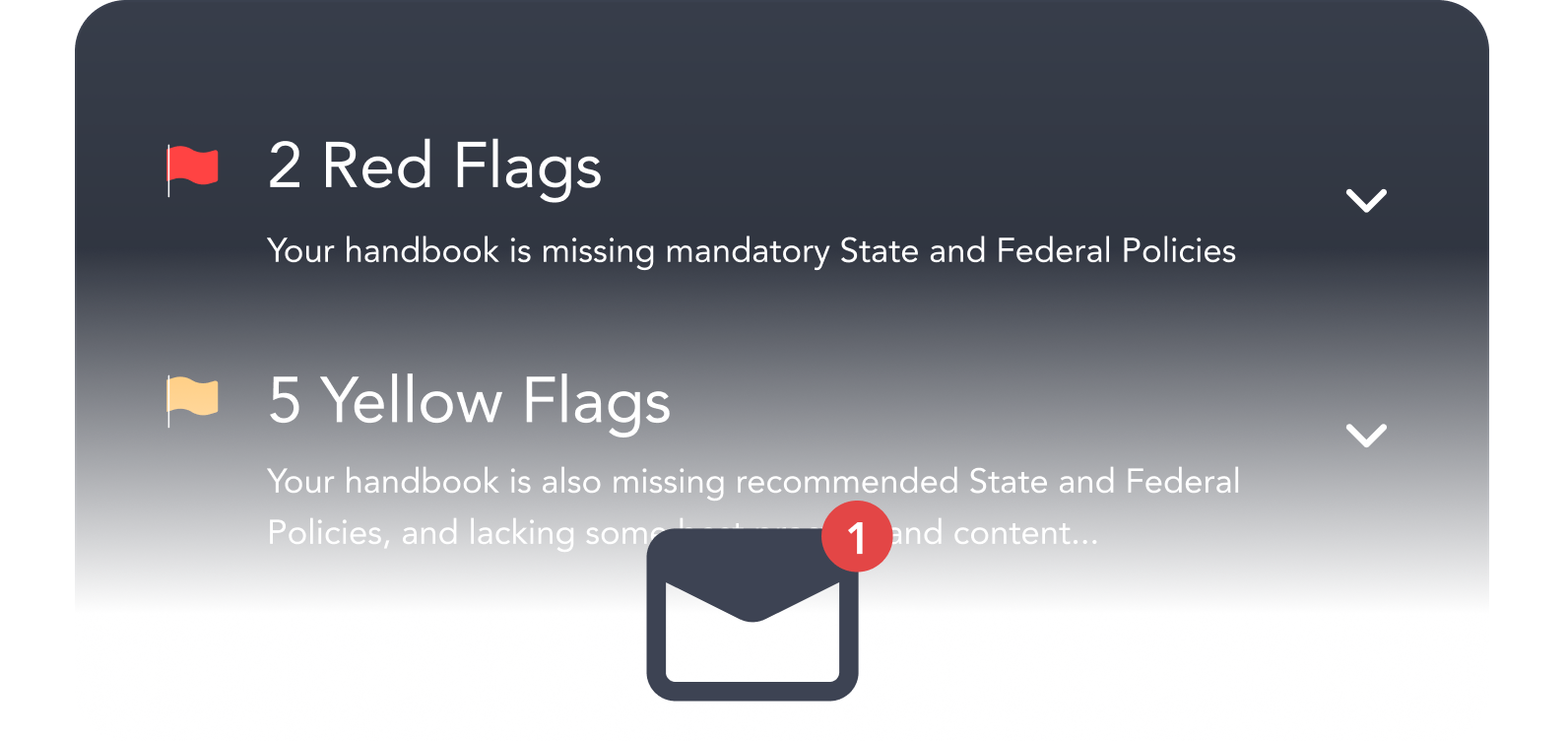
Understanding Texas Employee Handbook Requirements
Texas has a reputation as the most employer-friendly state in the country. At-will employment is the default, there's no state income tax, no state-mandated paid sick leave, no state FMLA equivalent, and just 9 state-specific handbook policies. Compared to California's 41 or Illinois's 28, Texas looks like a compliance vacation.
That reputation is earned, but it's also a trap.
The low policy count leads many Texas employers to assume they don't need a handbook at all, or that a generic federal-only template will suffice. Neither is true. Those 9 state policies are all classified as high-risk, meaning noncompliance creates direct legal exposure. And the absence of state-level protections doesn't eliminate employer obligations, it just means federal requirements (FMLA, FLSA, Title VII, ADA, USERRA) carry the full weight without any state-level cushion.
The 9 Texas-specific policies break down into four categories: Leave (4 policies covering military service, voting, emergency evacuation, and jury duty), Compliance (3 policies covering the CROWN Act, child labor, and equal employment), Wage & Hour (1 policy on wage deductions), and Termination Pay (1 policy on final wage payment). Every one of them is legally mandated, and every one of them has enforcement mechanisms with real consequences.
The bottom line: a handbook isn't legally "required" in Texas in the sense that no single statute says "you must have one." But written policies on anti-discrimination, wage deduction authorization, and leave protections are effectively required, and a handbook is the most practical way to document, distribute, and enforce them.
Why "Employer-Friendly" Doesn't Mean "Handbook-Optional"
Here's the uncomfortable truth about Texas employment law: the state's light regulatory touch actually makes a strong handbook more important, not less.
In states like California or New York, detailed statutes spell out exactly what employers must do in almost every employment scenario. That specificity creates compliance burden, but it also creates clarity. In Texas, the gaps in state law leave more room for disputes, and when disputes arise, your handbook is often the only document that defines the rules of the relationship.
Consider a few scenarios:
PTO and vacation policy. Texas has no state law requiring paid time off or vacation. But if your company offers PTO and an employee is terminated, the Texas Payday Law requires you to pay out any earned benefits according to your written policy. No written policy? The TWC will look at whatever informal practices you've established, and inconsistent treatment is a fast track to a wage claim or discrimination allegation.
At-will employment. Texas courts have upheld at-will as broadly as any state. But they've also recognized implied contract claims where handbooks or verbal promises created reasonable expectations of continued employment. A poorly worded handbook that lists "progressive discipline steps" without a clear at-will disclaimer can undermine the very doctrine you're relying on.
Drug testing. Texas has no general statute restricting employer drug testing (unlike California or New York). You have wide latitude, but you still need a written policy that's consistently applied. Without one, a terminated employee can argue the testing was arbitrary or discriminatory.
This is where a free handbook audit pays dividends. Even with just 9 state policies, your handbook needs to cover federal requirements, document company-specific policies clearly, and avoid language that inadvertently creates obligations you didn't intend.
Federal Requirements Texas Employers Can't Ignore
Because Texas has relatively few state-level employment laws, federal requirements carry outsized importance. Many Texas employers, especially smaller ones growing past key employee thresholds, underestimate what federal law demands.
Here are the major federal requirements that every Texas handbook should address:
- FMLA (50+ employees): 12 weeks of unpaid, job-protected leave for qualifying family and medical reasons. Texas has no state equivalent, so FMLA is your only leave obligation at this threshold.
- Title VII (15+ employees): Prohibits discrimination based on race, color, religion, sex, and national origin. The Texas Commission on Human Rights Act mirrors these protections and adds genetic information.
- ADA (15+ employees): Requires reasonable accommodations for qualified individuals with disabilities. Your handbook needs an interactive process description and an accommodation request procedure.
- FLSA (most employers): Minimum wage ($7.25/hour in Texas, matching the federal rate), overtime requirements, and exempt/non-exempt classification rules. Texas has no state minimum wage law that exceeds the federal floor.
- USERRA (all employers): Reemployment rights for military service members. Texas adds state-level protections under Government Code Chapter 437, but USERRA is the federal baseline.
- COBRA (20+ employees): Continuation of health coverage after termination. Texas has no state mini-COBRA law, so federal COBRA is the only safety net.
The common mistake? Assuming that because Texas doesn't layer state requirements on top of these federal laws, the federal requirements are somehow less important. They're not, they're your only requirements, which means getting them wrong has no state-level backup.
AirMason's handbook builder generates Texas-compliant handbooks that cover both the 9 state policies and all applicable federal requirements, so you're not just state-compliant, you're actually compliant.
Keeping Your Texas Handbook Current in 2026
Texas may not pass employment legislation at California's pace, but the state isn't standing still. Several recent changes affect what belongs in your handbook:
- CROWN Act (H.B. 567): Effective September 2023. If your dress code or grooming policy hasn't been updated since then, it likely needs attention. Hair texture and protective hairstyle protections are now part of the anti-discrimination framework.
- Child Labor Enforcement (H.B. 2459): Also effective September 2023. Penalties increased to up to $10,000 per violation, and a new Child Labor Tribunal system streamlined enforcement. Employers with workers under 18 should verify their scheduling practices and job duty assignments.
- Federal overtime rule reversal: A Texas federal court vacated the 2024 DOL rule that would have raised the exempt salary threshold to $58,656. The previous threshold of $35,568 ($684/week) remains in effect. If you adjusted salary classifications, review whether changes are still operationally necessary.
- E-Verify: While Texas doesn't have a universal E-Verify mandate like Florida, state agencies and contractors must use E-Verify. Private employers should monitor proposed legislation, as mandatory E-Verify bills are introduced regularly.
The broader pattern matters too. Federal employment law changes, from EEOC guidance on AI in hiring to NLRB rulings on non-compete agreements, affect Texas employers just as much as employers in heavily regulated states. Because Texas doesn't add its own layer, federal shifts hit Texas handbooks directly.
If you're not sure whether your current handbook accounts for these changes, run a free compliance audit. It checks against 1,000+ rules, takes minutes, and tells you exactly where the gaps are, even in an "employer-friendly" state like Texas.
Frequently Asked Questions
Explore Other State Requirements
More Resources
Build a Compliant Texas Employee Handbook
Expert-curated policies, updated weekly, built for how HR teams actually work.