Illinois Employee Handbook Requirements (2026)
Illinois has 28 state-specific policies your employee handbook needs to address, the second-most in the country behind California. Between the Paid Leave for All Workers Act, BIPA exposure, and Chicago layering its own rules on top, compliance here is a full-time job. Here's how to get it right.






At a Glance
Policy Breakdown by Category
Illinois requires 28 state-specific handbook policies. Here's what each one covers, without the legalese.
Leave
15 policiesWage & Hour
5 policiesCompliance
4 policiesBreaks
2 policiesBenefits
1 policyTermination Pay
1 policyNeed the Complete Illinois Addendum?
Get the full policy language for all 28 Illinois requirements, kept updated every week by our compliance team.
Talk to Our TeamCommon Compliance Pitfalls in Illinois
The mistakes we see most often, and how to avoid them.
The Illinois Paid Leave for All Workers Act (820 ILCS 192), effective January 1, 2024, makes Illinois one of only three states requiring paid leave for any reason, not just sick leave. Every employer in the state must provide 40 hours of paid leave per year, accrued at 1 hour per 40 hours worked. Employees can use it for literally anything: a mental health day, a kid's soccer game, a Tuesday they just don't feel like working.
That sounds straightforward until you add Chicago. The Chicago Paid Leave and Paid Sick and Safe Leave Ordinance (effective December 31, 2024) doesn't just mirror the state law. It adds to it. Chicago employers must provide:
- 40 hours of paid leave (usable for any reason, mirroring state law)
- 40 hours of paid sick leave (separate bank, restricted to illness, medical care, domestic violence, and similar qualifying reasons)
That's 80 total hours of protected paid time for Chicago employees, compared to 40 for the rest of the state. Employers who operate in both Chicago and downstate Illinois need two different leave policies. One won't cover both.
Common mistakes: treating the state law as sick leave (it's not, and you cannot require a reason), requiring documentation for state paid leave usage, and failing to carry over unused leave (Illinois requires it, though employers can cap usage at 40 hours per year). Chicago's sick leave must also carry over up to 80 hours.
The fix: Build separate leave banks for Chicago vs. rest-of-state employees. Train managers that the state paid leave requires zero justification. Update your handbook with both policies and make sure your PTO tracking system handles dual accrual.
Sources: 820 ILCS 192 (Paid Leave for All Workers Act); Chicago Paid Leave and Paid Sick and Safe Leave Ordinance (Municipal Code 1-24); Illinois Department of Labor Paid Leave FAQ (2024).
The Illinois Biometric Information Privacy Act (740 ILCS 14) isn't technically a "handbook policy," but it affects every employer that uses fingerprint scanners, facial recognition, or retina scans. The penalties are staggering: $1,000 per negligent violation and $5,000 per intentional or reckless violation. Per scan. Per employee.
BIPA requires employers to: (1) have a written policy for retention and destruction of biometric data, (2) inform employees in writing about what biometric data is collected and why, (3) obtain written consent before collecting any biometric data, and (4) never sell, lease, or profit from biometric data.
The settlement numbers speak for themselves. Facebook paid $650 million in 2021 for its photo-tagging feature. BNSF Railway was hit with a $228 million jury verdict in 2022 for scanning truck drivers' fingerprints without consent. White Castle settled for roughly $9.4 million in 2024 after the Illinois Supreme Court ruled each individual scan constituted a separate violation. Google paid $100 million in 2022 over Google Photos facial recognition.
What makes BIPA uniquely dangerous is the private right of action. Any affected individual can sue, not just a government agency. This has fueled a wave of class action litigation that shows no sign of slowing. In 2024 alone, over 200 BIPA lawsuits were filed in Illinois courts.
The fix: If you use any biometric timekeeping or access systems, you need a written BIPA policy in your handbook, a standalone consent form signed before the first scan, and a data retention schedule. Don't wait for a demand letter. The cost of compliance is a fraction of even the smallest BIPA settlement.
Sources: 740 ILCS 14 (Biometric Information Privacy Act); Cothron v. White Castle System, Inc., 2023 IL 128004; Rogers v. BNSF Railway Co. (N.D. Ill. 2022); In re Facebook Biometric Information Privacy Litigation (N.D. Cal. 2021); Rivera v. Google LLC (N.D. Ill. 2022).
Illinois amended the Equal Pay Act (820 ILCS 112) effective January 1, 2025, requiring employers with 15 or more employees to include the pay scale and benefits in any job posting. This applies to positions performed in Illinois or reporting to an Illinois supervisor, even if the employee works remotely from another state.
The definition of "job posting" is broad: it covers any external or internal listing, third-party recruiter postings, and positions advertised on job boards like Indeed or LinkedIn. Employers must also make the information available to current employees upon request for their own positions and for any promotion opportunities.
Penalties ramp up quickly:
- Civil penalties range from $500 for a first offense to $10,000 for subsequent violations
- The Illinois Department of Labor investigates complaints and can issue compliance orders
- Employees can also pursue private lawsuits for actual damages, compensatory damages, and attorneys' fees under the broader Equal Pay Act provisions
The Equal Pay Act goes further than federal law in several ways. It prohibits pay discrimination based on sex and race (the federal Equal Pay Act only covers sex). It restricts employers from asking about salary history. And it requires employers with 100+ employees to file an equal pay compliance statement and obtain a certificate from the Illinois Department of Labor.
The fix: Audit every active job posting for pay scale and benefits information. Establish internal pay bands before posting positions. Train recruiters and hiring managers on the new requirements. If you have 100+ employees, get your compliance certificate. Failure to obtain one is itself a violation.
Sources: 820 ILCS 112 (Illinois Equal Pay Act); SB 1480 (2021 amendments); HB 3129 (2024 pay transparency amendments); Illinois Department of Labor Equal Pay compliance guidance.
The Illinois One Day Rest in Seven Act (ODRISA, 820 ILCS 140) has been on the books since 1909, but amendments effective January 1, 2023, gave it serious enforcement power. Every employer must provide employees with at least 24 consecutive hours of rest in every calendar week. That's not a 7-day rolling period. It resets every Sunday-through-Saturday week.
The 2023 amendments also expanded meal and rest break requirements: employees working 7.5 continuous hours must receive a 20-minute meal break within the first 5 hours. For every additional 4.5 continuous hours, another 20-minute break is required.
Penalties increased dramatically:
- Fines range from $250 to $500 per offense (up from $25-$100)
- Each day of violation is a separate offense
- The Illinois Department of Labor can also issue compliance orders and pursue injunctive relief
Employers can apply for a permit from the IDOL allowing employees to voluntarily work on their scheduled day of rest, but the permit process requires evidence that the exception is genuinely voluntary and operationally necessary. Many employers don't realize the permit requirement exists.
Industries most at risk: healthcare, hospitality, manufacturing, and retail, anywhere shift scheduling routinely pushes through 7-day stretches. The amended law also specifically addresses hotel room attendants, who must receive two 15-minute paid rest breaks per shift and cannot be assigned more than a set number of rooms per day.
The fix: Audit scheduling practices to ensure every employee gets a 24-hour rest period in each calendar week. If 7-day stretches are operationally necessary, apply for an ODRISA permit immediately. Update time tracking to flag potential violations before they happen.
Sources: 820 ILCS 140 (One Day Rest in Seven Act); HB 2862 (2023 amendments); Illinois Department of Labor ODRISA FAQ and permit application guidance.
Under the Illinois Human Rights Act (775 ILCS 5/2-109), every Illinois employer, regardless of size, must provide annual sexual harassment prevention training to all employees. Not biennial like some states. Not just for supervisors. Every employee, every year.
The training must cover: the definition of sexual harassment under state and federal law, examples of conduct that constitutes unlawful sexual harassment, a summary of relevant federal and state statutory provisions, and the employer's internal complaint process and legal remedies available.
Restaurants and bars face additional requirements under SB 75 (effective July 1, 2020). They must provide:
- Supplemental sexual harassment training specific to the hospitality industry
- Bystander intervention training for all employees
- Managers must receive additional training on how to handle complaints and recognize warning signs
- A written sexual harassment policy in both English and Spanish (and any other language spoken by at least 5% of the workforce)
Penalties for non-compliance with the annual training requirement can reach $5,000 per offense per employee under the Illinois Human Rights Act. For restaurants and bars, the Illinois Department of Human Rights can seek additional penalties and even license implications.
Common gaps: not training new hires within the first calendar year, losing track of annual recurrence for existing employees, and using a generic national program that doesn't address Illinois-specific provisions (like the state's expanded definition of protected categories).
The fix: Implement annual training with automated tracking. Use Illinois-specific content, not a generic federal program. If you operate restaurants or bars, add the supplemental hospitality module and bystander training. Keep completion records for at least 5 years.
Sources: 775 ILCS 5/2-109 (Illinois Human Rights Act, training requirements); SB 75 (restaurant/bar supplemental training, effective July 1, 2020); Illinois Department of Human Rights model sexual harassment prevention training program.
Illinois Has 5 Employer Notice Requirements
Beyond handbook policies, Illinois employers must provide specific notices to employees for events like new hires, terminations, and qualifying events.
View Illinois Notice Requirements →Check Your Illinois Compliance in Minutes
Upload your handbook and get an instant compliance report, checked against 1,000+ rules including Illinois-specific requirements.
Try Our Free Employee Handbook Audit →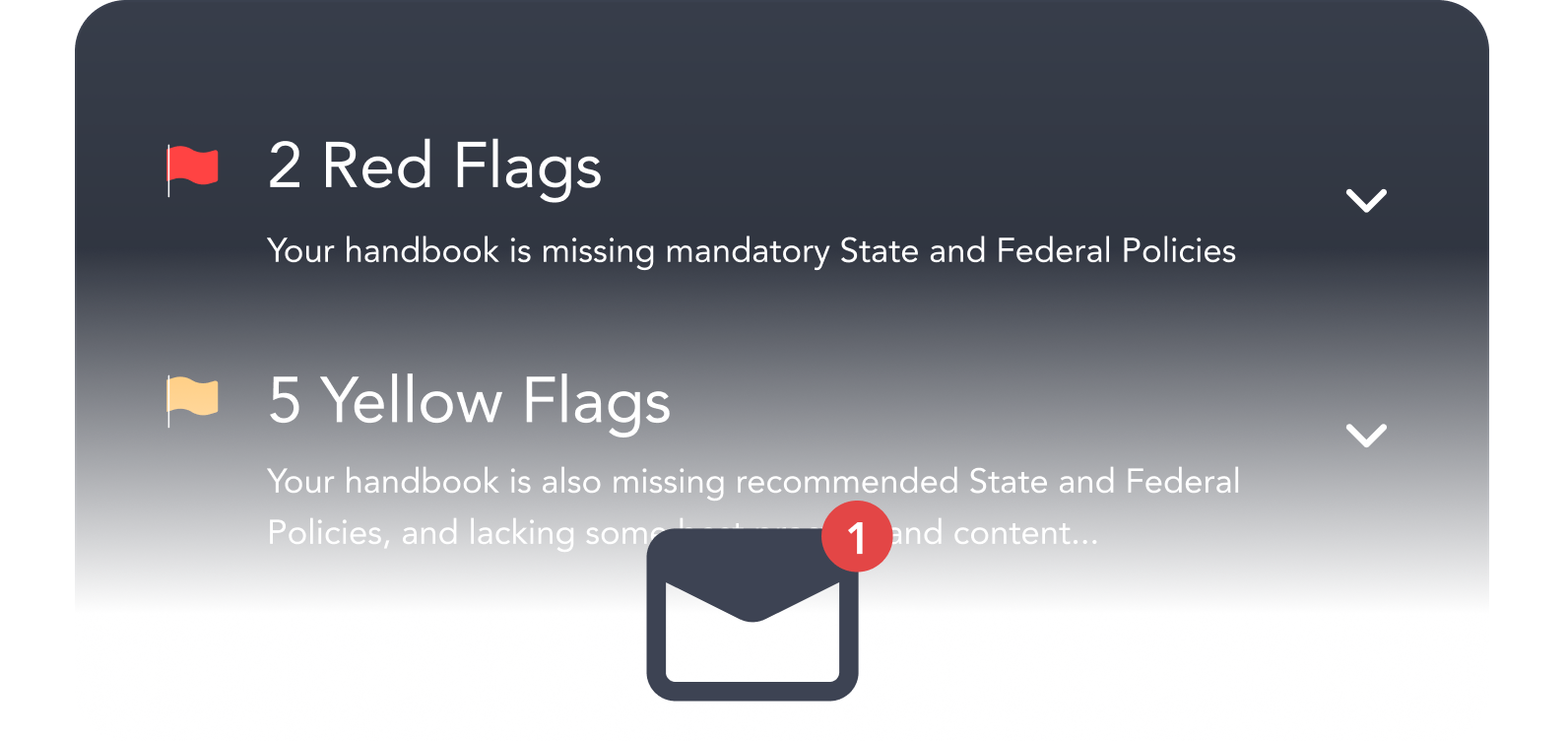
Understanding Illinois Employee Handbook Requirements
Illinois is quietly one of the most complex states for employee handbook compliance. Its 28 state-specific policies put it at number two nationally, right behind California's 41. If you've been treating Illinois like a standard Midwest state with a few leave laws on the books, it's time to recalibrate.
The volume is driven by two forces: an aggressive state legislature that has passed landmark employment legislation in recent sessions (the Paid Leave for All Workers Act in 2024, pay transparency in 2025, expanded equal pay protections), and the City of Chicago, which operates as a quasi-independent regulatory jurisdiction layering its own minimum wage, paid leave, and sick leave requirements on top of everything Springfield passes.
These 28 policies break down across six categories: Leave (15 policies, more than half the total), Wage & Hour (5 policies), Compliance (4 policies), Breaks (2 policies), Benefits (1 policy), and Termination Pay (1 policy). Of these, 27 are classified as high risk, meaning non-compliance carries real legal exposure: fines, private lawsuits, or both.
Then there's BIPA, the Biometric Information Privacy Act. It's not technically a handbook policy, but it affects any employer using fingerprint scanners, facial recognition, or similar biometric tools, and the penalty exposure dwarfs almost everything else on this list. If your handbook doesn't address biometric data, you're leaving a massive gap.
The Chicago Layer: A City With Its Own Employment Law Ecosystem
If California is complicated because of San Francisco and Los Angeles, Illinois is complicated because of Chicago. The city doesn't just tweak state law. It builds an entirely separate compliance layer that employers must navigate alongside (not instead of) state requirements.
The most impactful example is paid leave. The state Paid Leave for All Workers Act provides 40 hours of paid leave for any reason. Chicago's ordinance provides 40 hours of paid leave plus 40 hours of paid sick leave: separate banks, separate accrual rules, separate carryover provisions. An employer with workers in both Chicago and downstate Peoria literally needs two different leave policies.
Chicago's minimum wage also diverges from the state: $16.20/hour for large employers (21+ employees) and $15.00/hour for small employers (4-20 employees) as of July 2024, compared to the state minimum of $14.00/hour. The tipped minimum wage in Chicago is $11.02/hour, well above the state tipped minimum. Both adjust annually with CPI.
Cook County adds another layer with its own Earned Sick Leave Ordinance, which covers employees working in Cook County outside Chicago. So an employer with offices in Chicago, suburban Cook County, and Springfield may need three different sets of leave and wage policies.
The practical takeaway: if you have any employees working in Chicago or Cook County, a statewide Illinois handbook isn't sufficient. You need location-specific addenda, or better yet, a compliance audit that catches the local gaps your statewide policy misses.
Employee Count Thresholds: When New Illinois Requirements Kick In
Unlike some states that cluster most requirements at the 50-employee mark, Illinois spreads its thresholds across multiple tiers, so your compliance obligations shift as you grow, sometimes in unexpected ways.
- 1+ employee: Anti-discrimination and anti-harassment protections under the Illinois Human Rights Act, annual sexual harassment training, pregnancy accommodation, nursing mother breaks, Paid Leave for All Workers Act (40 hours), VESSA domestic violence leave, jury duty and witness leave, voting leave, emergency response leave
- 4+ employees (Chicago): Chicago minimum wage for small employers ($15.00/hour), Chicago paid leave and paid sick leave
- 15+ employees: Family military leave, pay scale disclosure in job postings (Equal Pay Act amendment), semi-monthly pay schedule requirements under the Wage Payment and Collection Act
- 21+ employees (Chicago): Chicago minimum wage for large employers ($16.20/hour)
- 50+ employees: School conference and activity leave, crime victim leave, extended child bereavement leave, blood donation leave, organ/bone marrow donation leave, Chicago-area transit pass benefit, enhanced final pay penalties (2% monthly on unpaid wages)
The counting methodology matters. Some Illinois laws count all employees regardless of location (the Equal Pay Act uses company-wide headcount), while others count only Illinois-based employees. Chicago's ordinances typically count employees working within city limits. Getting the count wrong in either direction creates risk.
If your company is approaching any of these thresholds, run a free handbook audit to see exactly which new requirements apply before you're technically in violation.
Keeping Your Illinois Handbook Current in 2026
Illinois employment law has been on an unusually active streak. Over the past three legislative sessions, the state has introduced the Paid Leave for All Workers Act, expanded pay transparency requirements, strengthened One Day Rest in Seven protections, and, through Chicago, created one of the most generous local paid leave frameworks in the country. Staying current isn't optional; it's a moving target.
For 2026, Illinois employers should be tracking:
- Pay transparency enforcement: The Equal Pay Act amendments requiring pay scales in job postings took effect January 1, 2025, and the Illinois Department of Labor is actively investigating complaints. Early enforcement actions are expected to set the tone for compliance expectations.
- Chicago Paid Leave and Paid Sick Leave adjustments: The city ordinance includes provisions for regulatory guidance updates. Employers should watch for updated FAQs and enforcement bulletins from the Chicago Department of Business Affairs and Consumer Protection.
- BIPA litigation developments: The Illinois Supreme Court's 2023 ruling capping per-scan damages to a single claim per scanning context (Cothron v. White Castle) reduced some exposure, but BIPA class actions continue at a rapid pace. New biometric-related bills are regularly introduced in Springfield.
- Minimum wage increases: Both the state minimum wage ($14.00/hour in 2024, with scheduled annual increases) and Chicago's minimum wage (CPI-adjusted annually) will continue to rise. Handbook wage references need annual updates.
- Ongoing ODRISA enforcement: The strengthened One Day Rest in Seven Act penalties are relatively new, and the Illinois Department of Labor is ramping up enforcement. Scheduling audits should be routine.
The pattern is clear: Illinois is trending toward more employee protections, not fewer, and Chicago is often a year or two ahead of the state. AirMason's handbook builder tracks these changes weekly and pushes updates to customers, so your handbook reflects current law without requiring you to monitor every bill in Springfield and every ordinance from City Hall.
Not sure if your handbook covers 2026 requirements? Run a free compliance audit. It checks against 1,000+ rules, including Illinois state and Chicago-specific requirements.
Frequently Asked Questions
Explore Other State Requirements
More Resources
Build a Compliant Illinois Employee Handbook
Expert-curated policies, updated weekly, built for how HR teams actually work.