Tennessee Handbook Requirements (2026)
Tennessee has state-specific policies your employee handbook needs to address. The state has one of the most generous parental leave mandates in the Southeast (4 months for employers with 100+ employees), plus child labor violations that carry felony charges. Here's the full picture. Please keep in mind requirements may vary based on company size, industry, location, and workforce composition.






At a Glance
Policy Breakdown by Category
Tennessee requires 11 state-specific handbook policies. Here's what each one covers, without the legalese.
Leave
5 policiesCompliance
3 policiesWage & Hour
2 policiesTermination Pay
1 policyNeed the Complete Tennessee Addendum?
Get the full policy language for all 11 Tennessee requirements, kept updated every week by our compliance team.
Talk to Our TeamCommon Compliance Pitfalls in Tennessee
The mistakes we see most often, and how to avoid them.
Under TCA 4-21-408, employers with 100 or more full-time employees at a single job site must allow up to 4 months of leave for pregnancy, childbirth, adoption, and nursing an infant. This is not the same as FMLA's 12 weeks. It is 16 weeks, and it applies to both mothers and fathers.
The law has several specific requirements that catch employers off guard:
- 12-month tenure requirement: The employee must have worked for the same employer for at least 12 consecutive months as a full-time employee.
- 3-month advance notice: Employees must provide at least 3 months' notice of their intent to take leave, except in cases of medical emergency.
- Job restoration: The employee must be restored to their previous or a comparable position upon return. Failure to reinstate triggers a discrimination claim under the Tennessee Human Rights Act.
- "One job site" counting: The 100-employee threshold is counted at a single location, not company-wide. A company with 300 employees across 5 locations of 60 each would not trigger the requirement at any location.
Because violations are enforced through the Tennessee Human Rights Commission under the same framework as discrimination claims, remedies include back pay, compensatory damages, attorney fees, and reinstatement. This is not a minor penalty structure.
The fix: Count your full-time headcount at each job site separately. If any site reaches 100, add a parental leave policy to your handbook. Build tracking for the 3-month notice requirement and the 12-month tenure eligibility. Do not confuse this with FMLA, as they are separate programs with different rules and timelines.
Sources: TCA 4-21-408; Tennessee Human Rights Commission enforcement guidance; Tenn. Comp. R. & Regs. 1120-06-.20.
Tennessee takes child labor seriously, and the penalty structure reflects it. Under TCA 50-5-112, employing a child under the age of 14 is a Class D felony, punishable by 2 to 12 years in prison and a fine of up to $5,000 for an individual or $125,000 for a business entity. This is not a civil penalty. It is a criminal charge.
For minors aged 14 and 15, the restrictions are detailed under TCA 50-5-105 and related sections:
- Maximum 3 hours per day on school days, 8 hours on non-school days
- Maximum 18 hours per week during school weeks, 40 hours during non-school weeks
- Cannot work before 7:00 a.m. or after 7:00 p.m. during the school year (9:00 p.m. June 1 through Labor Day)
All minors under 18 must have a work permit (also called an age certificate) before beginning employment. The employer is responsible for verifying the permit is on file.
Nationally, the U.S. Department of Labor reported a 31% increase in child labor violations since pre-COVID levels, with the food and drink service sector accounting for 84% of verified violations in 2024. Tennessee is no exception to this trend.
The fix: Verify work permits for every employee under 18 before their first shift. Program your scheduling system to enforce Tennessee's hour restrictions for minors. Train hiring managers that age verification is not optional. If you operate in food service, retail, or any industry that commonly employs teenagers, audit your practices quarterly.
Sources: TCA 50-5-112 (penalties); TCA 50-5-105 (hour restrictions); U.S. DOL child labor enforcement data (2024); Tennessee Department of Labor and Workforce Development.
Federal Title VII requires 15 employees before anti-discrimination protections apply. The Tennessee Human Rights Act (TCA 4-21-401 et seq.) sets the bar at just 8 employees. That means a small office, a retail store, or a restaurant with 8 staff members is covered by the state's anti-discrimination framework.
Protected classes under Tennessee law include race, color, religion, sex, age (40 and older), national origin, and disability. The Tennessee Human Rights Commission (THRC) investigates complaints and can order remedies including back pay, compensatory damages, attorney fees, and reinstatement.
An important distinction: Tennessee law requires employees to file a charge with the THRC before bringing a lawsuit in state court. The filing deadline is 180 days from the alleged discriminatory act for most claims, shorter than the federal 300-day window. Employees who miss the THRC deadline may still have recourse under federal law if the federal threshold is met, but the state claim would be barred.
The practical impact for small employers: if you have 8 to 14 employees, you are covered by Tennessee's anti-discrimination law but not by federal Title VII. Many small business owners do not realize they have state-level obligations until a complaint is filed.
The fix: If you have 8 or more employees in Tennessee, you need a written anti-discrimination and anti-harassment policy, a complaint investigation procedure, and regular training. Do not assume the federal 15-employee exemption applies. It does not under state law.
Sources: TCA 4-21-401 et seq. (Tennessee Human Rights Act); Tennessee Human Rights Commission enforcement data; TCA 4-21-311 (remedies and enforcement).
Under TCA 50-2-103, employers must pay all earned wages to a separated employee by the next regular payday or within 21 days of separation, whichever occurs later. This applies to both voluntary resignations and involuntary terminations.
What distinguishes Tennessee from many other states: under TCA 50-2-104, an employer who fails to pay wages when due is guilty of a Class B misdemeanor, punishable by up to 6 months in jail and a $500 fine. This is a criminal penalty, not a civil one. While criminal prosecution is not common, the statute is on the books and enforceable.
Employees also have a private right of action. Under TCA 50-2-103(b), an employee who is not paid timely can recover the unpaid wages plus a reasonable attorney fee. In practice, the attorney fee risk often exceeds the wage amount itself, making even small final pay delays expensive to litigate.
"All earned wages" means base pay through the last hour worked plus any compensation the employee has a right to under the employer's written policies. If your handbook promises payment for accrued vacation, that amount must be included in the final check.
The fix: Process final pay within the 21-day window or by the next regular payday, whichever is later. Build a termination checklist covering base wages, accrued leave (if policy provides it), and earned commissions. Do not treat the 21-day limit as a target. Aim to pay within the first week.
Sources: TCA 50-2-103 (wage payment), TCA 50-2-104 (criminal penalty); Tennessee Department of Labor and Workforce Development.
Tennessee Has 4 Employer Notice Requirements
Beyond handbook policies, Tennessee employers must provide specific notices to employees for events like new hires, terminations, and qualifying events.
View Tennessee Notice Requirements →Check Your Tennessee Compliance in Minutes
Upload your handbook and get an instant compliance report, checked against 1,000+ rules including Tennessee-specific requirements.
Try Our Free Employee Handbook Audit →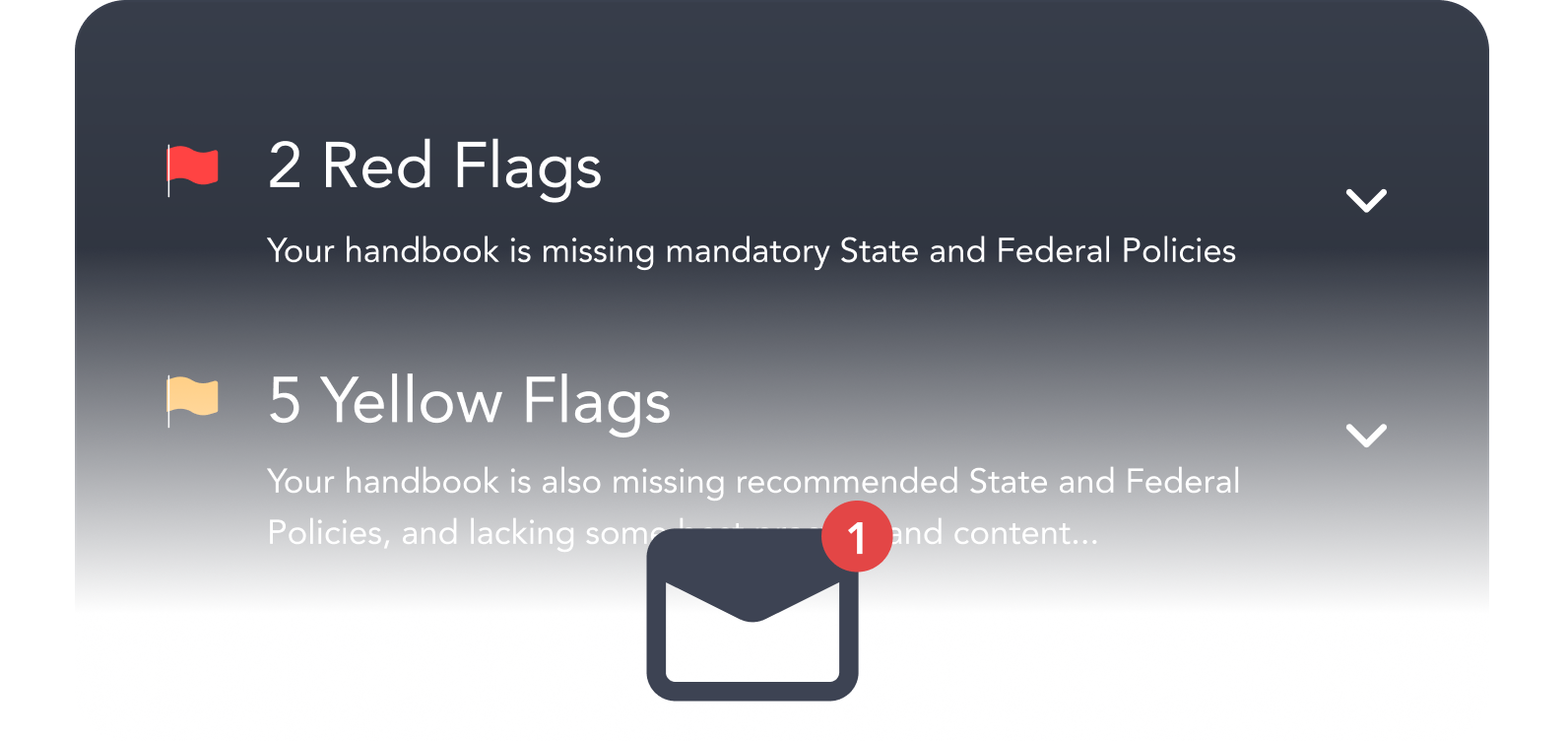
Understanding Tennessee Employee Handbook Requirements
Tennessee's 11 state-specific handbook policies place it squarely in the moderate category. The state does not match California's 41 or Illinois's 28, but the policies it does have pack genuine enforcement weight. Child labor violations can result in felony charges. Anti-discrimination coverage starts at just 8 employees. And the parental leave mandate (4 months for employers with 100+ at a single site) is one of the most generous in the Southeast.
These 11 policies break down into four categories: Leave (5 policies), Compliance (3 policies), Wage and Hour (2 policies), and Termination Pay (1 policy). Ten of the 11 are high-risk, meaning non-compliance carries enforcement consequences. The only medium-risk policy is minimum wage, since Tennessee does not have a state minimum wage law and defaults to the federal $7.25 floor.
Tennessee is also notable for its lawful off-duty conduct protections under TCA 50-1-304, which shield employees from adverse action for the legal use of agricultural products (a broad category that includes tobacco and certain other products) outside of work. This is worth knowing if your handbook includes lifestyle or off-duty conduct policies.
Tennessee's Parental Leave vs. FMLA: They Are Not the Same Thing
One of the most common mistakes Tennessee employers make is treating the state's parental leave law (TCA 4-21-408) as interchangeable with federal FMLA. They are separate programs with different rules, and the differences matter.
FMLA provides 12 weeks (about 3 months) of leave and applies to employers with 50 or more employees within 75 miles. Tennessee's parental leave provides up to 4 months and applies at 100 or more full-time employees at a single job site. The Tennessee law covers pregnancy, childbirth, adoption, and nursing. FMLA is broader, covering serious health conditions and family member care as well.
The two programs can run concurrently. An employee taking leave for pregnancy at a qualifying employer would use both Tennessee parental leave and FMLA time simultaneously. But after 12 weeks of FMLA expire, the employee may still have additional time remaining under the Tennessee law (up to 4 additional weeks). Terminating an employee after FMLA expires but before the Tennessee leave period ends creates a discrimination claim.
The "single job site" counting method also differs from FMLA. FMLA counts employees within 75 miles. Tennessee's law counts full-time employees at one location. A company with 200 total employees split across three offices of 65 each would trigger FMLA but not the Tennessee parental leave law at any individual site.
AirMason's handbook builder generates separate policy sections for state and federal leave programs so employees understand which protections apply to their specific situation.
Employee Count Thresholds in Tennessee
Tennessee's compliance obligations scale with headcount at several key thresholds:
- 1 employee: Nursing mother breaks (TCA 50-1-305), wage payment timing (TCA 50-2-103), voting leave (TCA 2-1-106), jury duty protection (TCA 22-4-108)
- 8 employees: Tennessee Human Rights Act anti-discrimination protections (TCA 4-21-401 et seq.), covering race, color, religion, sex, age, national origin, and disability
- 15 employees: Federal Title VII applicability, ADA applicability
- 20 employees: Federal ADEA (age discrimination) applicability
- 50 employees: Federal FMLA applicability (12 weeks job-protected leave)
- 100 employees (at one job site): Tennessee Parental Leave Act (up to 4 months leave for pregnancy, childbirth, adoption, nursing)
The 8-employee threshold is particularly important for small businesses. A company with just 8 staff members has full anti-discrimination obligations under state law, even though federal Title VII would not apply until 15. If you are growing toward any of these milestones, a free compliance audit will flag which new policies need to be added.
Keeping Your Tennessee Handbook Current in 2026
Tennessee's employment law landscape is relatively stable compared to high-activity states like California or New York. But "stable" does not mean "static." Here are the developments worth monitoring in 2026:
- Federal salary threshold reversion: The DOL's 2024 attempt to raise the exempt employee salary threshold was vacated by a federal court in November 2024, reverting the threshold to $684/week ($35,568/year). Tennessee employers who adjusted salaries during the 2024 shuffle should audit their current exempt classifications.
- Child labor enforcement: The U.S. DOL has increased enforcement activity on child labor violations, with a 31% increase in verified violations since pre-COVID levels. Tennessee employers in food service, retail, and hospitality should expect continued scrutiny.
- TCA 50-1-304 (lawful off-duty conduct): As cannabis policy evolves nationally, Tennessee's lawful off-duty conduct protections may intersect with changing substance use norms. The current statute protects legal product use outside of work.
If your Tennessee handbook has not been reviewed in the past 12 months, running a free compliance audit is the fastest way to identify gaps. AirMason's audit checks against 1,000+ rules and takes just minutes to complete.
Frequently Asked Questions
Explore Other State Requirements
More Resources
Build a Compliant Tennessee Employee Handbook
Expert-curated policies, updated weekly, built for how HR teams actually work.