North Carolina Employee Handbook Requirements (2026)
North Carolina has state-specific policies your employee handbook needs to address. The count is modest, but E-Verify mandates, unusually strict wage deduction rules, and a set of leave types you won't find in most other states mean there's more to get right than the number suggests. Please keep in mind requirements may vary based on company size, industry, location, and workforce composition.






At a Glance
Policy Breakdown by Category
North Carolina requires 11 state-specific handbook policies. Here's what each one covers, without the legalese.
Leave
6 policiesCompliance
2 policiesImmigration Law
1 policyWage & Hour
1 policyTermination Pay
1 policyNeed the Complete North Carolina Addendum?
Get the full policy language for all 11 North Carolina requirements, kept updated every week by our compliance team.
Talk to Our TeamCommon Compliance Pitfalls in North Carolina
The mistakes we see most often, and how to avoid them.
North Carolina requires all employers with 25 or more employees to use E-Verify for every new hire, and you have just 3 business days from the hire date to run the check. The threshold counts employees physically working in North Carolina, regardless of where your company is headquartered, but seasonal workers employed for fewer than 9 months in a calendar year are excluded from the count.
Here's what trips employers up: the enforcement model is complaint-driven. The NC Department of Labor doesn't conduct random audits or proactive sweeps. Investigations only happen when someone files a formal complaint alleging a violation of N.C. Gen. Stat. Section 64-26. That leads many employers to assume the law is optional in practice. It's not.
The penalty structure escalates quickly:
- First violation: You must sign a sworn affidavit within 3 business days confirming you've initiated verification. Fail to file that affidavit, and you move to active penalty territory.
- Second violation: Sworn affidavit plus a $1,000 civil penalty.
- Subsequent violations: Fines scale up to $10,000 per offense.
The bigger risk is indirect. Government contracts in North Carolina require E-Verify compliance under N.C. Gen. Stat. Section 143-133.3. A company that wins a state or municipal contract without being enrolled in E-Verify risks contract termination and debarment from future government work. For construction firms, staffing agencies, and IT companies bidding on state projects, this is the real financial exposure.
The fix: Enroll in E-Verify before you hit 25 NC employees, not after. Build the verification step into your onboarding checklist so it happens automatically within the 3-day window. Keep records of every verification. If you bid on government contracts, make E-Verify compliance a standing agenda item for your HR team.
Sources: N.C. Gen. Stat. Section 64-26; N.C. Gen. Stat. Section 143-133.3; NC DOL E-Verify Information; NC DOL E-Verify FAQs.
North Carolina's wage deduction statute (N.C. Gen. Stat. Section 95-25.8) is stricter than what many employers expect, especially those relocating from states where broader paycheck deductions are permitted with minimal formality.
Here's the core rule: every deduction requires specific written authorization signed by the employee on or before the payday for the pay period from which the deduction will be taken. That authorization must include the reason for the deduction and the exact dollar amount or percentage. Generic blanket consent buried in an onboarding packet doesn't meet the standard.
When the amount isn't known in advance (think damage to company property or cash register shortages), the employer must:
- Get written authorization in advance that identifies the reason
- Provide advance written notice of the actual amount before the deduction hits
- Notify the employee of their right to withdraw the authorization
- Give the employee a reasonable opportunity to withdraw in writing
That withdrawal right is the piece most employers miss entirely. Even when you have signed authorization, the employee can pull it back, and you must stop the deduction.
There's one narrow exception: if criminal process has been issued against an employee, they've been indicted, or arrested for a charge related to a cash shortage, inventory shortage, or property damage, the employer may withhold wages to recoup the amount without written authorization. But if the employee is not found guilty, the employer must reimburse every dollar deducted.
Violations open the door to claims under N.C. Gen. Stat. Section 95-25.22, which allows employees to recover the full amount of unpaid or improperly deducted wages plus double damages (liquidated damages equal to the amount withheld) and reasonable attorney's fees. A $500 improper deduction can become a $1,500 judgment before legal costs.
The fix: Create a standalone wage deduction authorization form that is separate from your general onboarding paperwork. Include the deduction reason, the exact amount, and a clear statement of the employee's right to withdraw. Get a fresh signature for each new deduction. Never deduct first and document later.
Sources: N.C. Gen. Stat. Section 95-25.8; N.C. Gen. Stat. Section 95-25.22; NC DOL: Deductions from Wages.
The Retaliatory Employment Discrimination Act (N.C. Gen. Stat. Section 95-240 through 95-245) is North Carolina's primary whistleblower protection law. It prohibits employers from retaliating against employees who file or threaten to file complaints related to workplace safety, wage and hour violations, workers' compensation claims, mine safety, and several other protected activities spread across 11 referenced statutes.
Here's the catch that makes REDA uniquely dangerous for employers: the government almost never enforces it directly. The NC Department of Labor's Retaliatory Employment Discrimination Bureau received over 10,000 complaints across a multi-year span, yet the Bureau and the state Attorney General's office brought only one case on a worker's behalf during that period. The enforcement record is, by the state's own data, extraordinarily thin.
That sounds like good news for employers. It isn't. When the Bureau investigates a complaint and finds no violation (or simply declines to act), the employee receives a right-to-sue letter and has 90 days to file a private civil action. The practical effect is that REDA complaints function as a gateway to litigation, not a substitute for it.
In a private REDA lawsuit, remedies include:
- Reinstatement or front pay
- Back pay for lost wages
- Reasonable attorney's fees and costs
- Injunctive relief
The scope of protected activities is broad enough to surprise employers who think REDA only covers safety complaints. Filing a wage claim, reporting a workers' comp injury, cooperating with OSHA, or even threatening to file a complaint all qualify. The word "threaten" matters: an employee doesn't need to have actually filed anything to be protected.
The fix: Train supervisors that any adverse action taken shortly after an employee raises a workplace safety concern, files a wage complaint, or reports a workers' comp injury will be scrutinized through the lens of REDA. Document the legitimate business reasons for every termination, demotion, or schedule change. Never reference a complaint or protected activity in disciplinary records.
Sources: N.C. Gen. Stat. Sections 95-240 through 95-245 (REDA); NC DOL Retaliatory Employment Discrimination Bureau; NC DOL: Protected Activities under REDA.
North Carolina has a handful of leave requirements you won't find on most multistate employers' radar. They're small in scope but easy to violate, and the penalties for retaliation can be disproportionate to the leave itself.
Parental School Involvement Leave (N.C. Gen. Stat. Section 95-28.3) requires employers to grant up to 4 hours per year so a parent, guardian, or person standing in loco parentis can attend or be involved at their child's school. That's 4 total hours per calendar year, not per child. Employers can require 48 hours' written notice and written verification from the school. What employers get wrong: they deny the leave entirely because they've never heard of the statute, or they grant 4 hours per child and later try to claw back the excess time.
Disaster Response Leave allows certified American Red Cross volunteers to take up to 15 days of leave in a 12-month period when called to respond to a disaster. This applies to employers with 20 or more employees. The leave is unpaid unless the employer has a more generous policy, but retaliation is prohibited.
Precinct Official Leave protects employees who serve as election officials. The leave itself is brief (typically one day per election), but terminating or penalizing an employee for serving creates liability under North Carolina election law.
Juvenile Court Compliance Leave requires employers to allow parents and guardians time off to comply with juvenile court orders. This could include attending hearings, meeting with probation officers, or completing court-ordered activities. Firing or demoting an employee for taking this leave is prohibited.
The fix: Add a "North Carolina-specific leaves" section to your handbook that covers all four types. The 4-hour school involvement leave is the one most likely to generate complaints, so build it into your time-off request system. For the others, train managers to recognize the protected activity and route requests to HR rather than denying them on the spot.
Sources: N.C. Gen. Stat. Section 95-28.3 (School Involvement Leave); N.C. Gen. Stat. Chapter 95, Article 2A; NC DOL: Parental Leave.
Under N.C. Gen. Stat. Section 95-25.7, when an employee is separated for any reason (termination, layoff, resignation, or mutual agreement), all wages owed must be paid on or before the next regular payday. The employee can request payment by mail. For wages calculated on commissions or bonuses, payment is due on the first regular payday after the amount becomes calculable.
Compared to states like California (same-day for terminations) or Illinois (next payday or within 24 hours, depending on the circumstances), North Carolina's "next regular payday" standard is relatively forgiving. But that relative leniency leads to complacency, and complacency leads to missed deadlines.
The most common mistakes:
- Forgetting accrued benefits. If your handbook or employment agreement promises PTO payout on separation, that payout is a wage under North Carolina law. Failing to include it in the final check violates the statute. Note that North Carolina does not require PTO payout by default; it only becomes mandatory when your own policy says it will be paid.
- Holding pay pending equipment return. This is not permitted. You cannot condition final wages on the return of a laptop, badge, or uniform.
- Commission disputes. Employers sometimes delay commission payments indefinitely after a separation, claiming the amount isn't "calculable." Courts take a dim view of this when the calculation formula is straightforward.
When an employer fails to pay on time, employees can sue under N.C. Gen. Stat. Section 95-25.22 to recover the unpaid wages plus liquidated damages equal to the amount owed (effectively doubling the liability) plus reasonable attorney's fees and costs. An employer who withholds $3,000 in final pay faces a $6,000 judgment plus the employee's legal fees, which can easily exceed the underlying wage claim.
The fix: Process final pay on the same payroll cycle you process the separation. Build a final pay checklist that includes base wages, earned commissions, and any PTO payout your policy promises. Never tie final pay to equipment return. If a commission amount is genuinely in dispute, pay the undisputed portion on time and resolve the rest as quickly as possible.
Sources: N.C. Gen. Stat. Sections 95-25.7 and 95-25.22; NC DOL: Payment of Final Wages to Separated Employees; SB 208 (2021 amendments to pay notice and final wage provisions).
North Carolina Has 3 Employer Notice Requirements
Beyond handbook policies, North Carolina employers must provide specific notices to employees for events like new hires, terminations, and qualifying events.
View North Carolina Notice Requirements →Check Your North Carolina Compliance in Minutes
Upload your handbook and get an instant compliance report, checked against 1,000+ rules including North Carolina-specific requirements.
Try Our Free Employee Handbook Audit →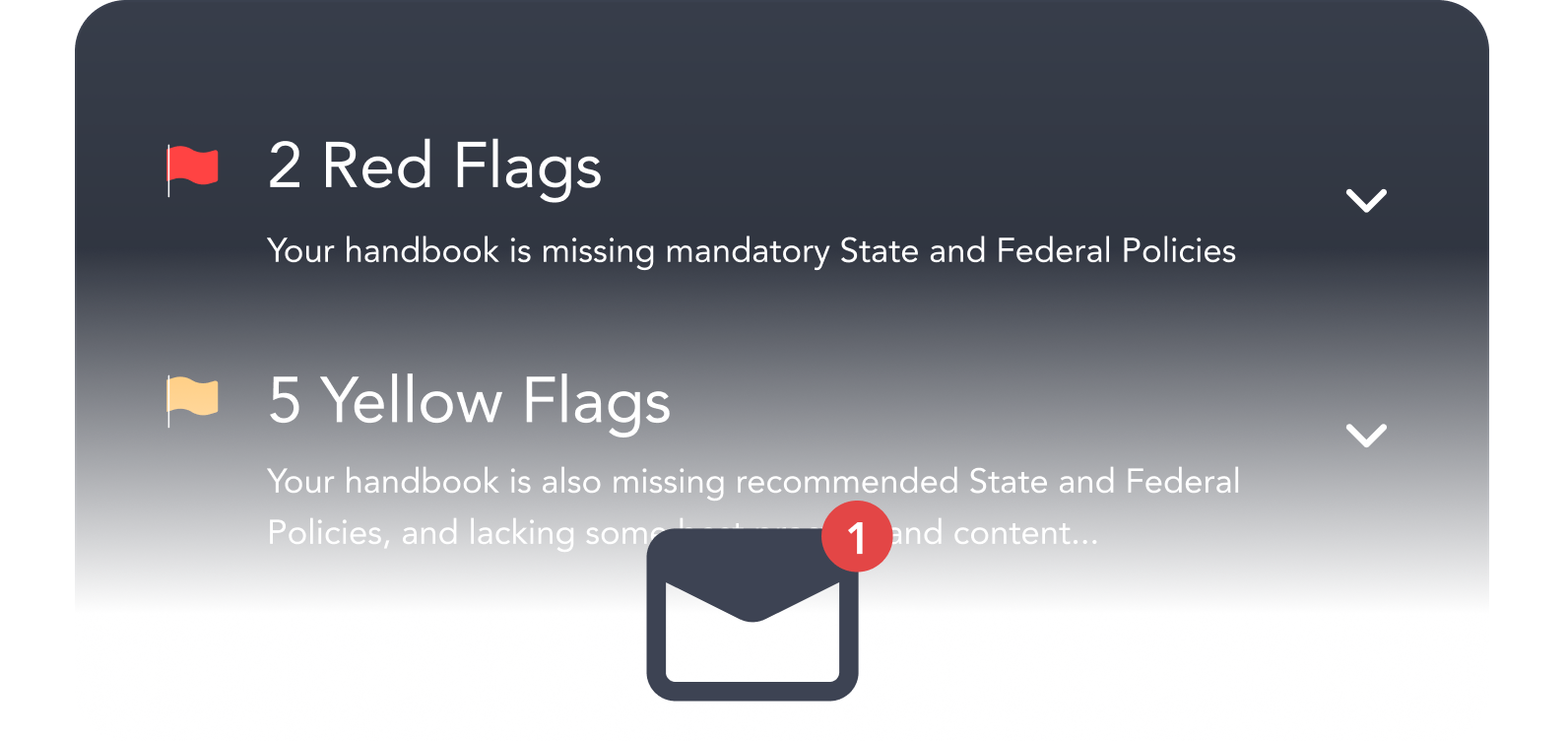
Understanding North Carolina Employee Handbook Requirements
North Carolina sits in a middle ground that catches employers off guard. With 11 state-specific policies, it's far from the regulatory density of California or New York. But it's also not the blank slate that some Southern states offer. The state has real teeth in areas like wage deductions and E-Verify compliance, and it layers on a handful of leave protections that don't exist anywhere else in the country.
These 11 policies break into five categories: Leave (6 policies), Compliance (2 policies), Immigration Law (1 policy), Wage & Hour (1 policy), and Termination Pay (1 policy). Every single one carries high compliance risk. There are no "nice to have" policies on this list.
The leave category is where North Carolina stands apart. While most states cover jury duty and military leave, North Carolina adds parental school involvement leave (4 hours per year), disaster response volunteer leave (for certified Red Cross volunteers), precinct official leave (for election workers), and leave for parents complying with juvenile court orders. These are narrow, low-hour protections, but they carry retaliation penalties that make denying them a costly mistake.
For employers expanding into North Carolina or managing a multistate workforce, the key insight is this: the state's low policy count creates a false sense of simplicity. The policies that do exist have specific procedural requirements, particularly around wage deductions and E-Verify, that punish employers who treat North Carolina compliance as an afterthought.
E-Verify and Immigration Compliance in North Carolina
North Carolina was one of the earlier states to mandate E-Verify for private employers, and its threshold of 25 or more employees is lower than many other mandatory E-Verify states. The law, codified in N.C. Gen. Stat. Chapter 64, has been in effect since July 2013 and applies to any employer with 25 or more workers physically located in North Carolina, regardless of where the company is headquartered.
The employee count has a notable wrinkle: workers employed for fewer than 9 months in a calendar year are excluded from the threshold calculation. This primarily benefits agricultural employers and seasonal businesses, but any employer with a mix of full-time and seasonal staff should understand how the count works.
Verification must happen within 3 business days of the employee's hire date. An employer that consistently runs E-Verify checks within this window is presumed compliant under the statute, which provides meaningful protection if a complaint is ever filed.
The enforcement mechanism is complaint-driven, meaning the NC Department of Labor does not audit employers proactively. But complaints can come from competitors, former employees, or advocacy organizations, and the penalty structure escalates from a sworn affidavit requirement on the first offense to civil fines of $1,000 to $10,000 for repeat violations. Government contractors face an additional layer: N.C. Gen. Stat. Section 143-133.3 requires E-Verify compliance as a condition of public contracts, and non-compliance can result in contract termination.
If your company is approaching the 25-employee threshold in North Carolina, the practical move is to enroll in E-Verify early and integrate the verification step into your standard onboarding process. Waiting until you hit the threshold and then scrambling to comply creates exactly the kind of gap that generates complaints.
Wage Rules and Final Pay: What North Carolina Gets Strict About
North Carolina's Wage and Hour Act (N.C. Gen. Stat. Chapter 95, Article 2A) covers wage deductions, final pay timing, and the remedies available to employees when employers get it wrong. Two areas in particular create more liability than most employers anticipate.
Wage deductions under Section 95-25.8 require written authorization that meets specific criteria: the employee's signature must be on or before the payday for the affected pay period, the authorization must state the reason and the exact dollar amount or percentage, and the employee must be notified of their right to withdraw the authorization at any time. When the deduction amount isn't known in advance, the employer must provide additional written notice of the actual amount before it's taken. The withdrawal right is the provision that catches most employers by surprise. Even with a valid signed authorization, the employee can revoke it, and the employer must stop the deduction immediately.
Final pay under Section 95-25.7 must be delivered by the next regular payday after separation, regardless of the reason for separation. Commissions and bonuses are due on the first regular payday after the amount becomes calculable. North Carolina does not require PTO payout by default, but if your handbook or employment agreement promises it, the payout becomes an enforceable wage obligation.
The enforcement mechanism matters here: employees who sue under Section 95-25.22 can recover the full amount of unpaid or improperly deducted wages, plus liquidated damages equal to the amount owed, plus reasonable attorney's fees. This doubling provision turns relatively small disputes into economically viable lawsuits for plaintiff's attorneys, which means even modest violations tend to get litigated.
For HR teams, the takeaway is to treat every wage deduction as a formal transaction requiring standalone documentation, and to process final pay on the same cycle you process the separation itself. Delays and informal practices are where the exposure builds.
Keeping Your North Carolina Handbook Current in 2026
North Carolina's legislative environment is less active than states like California or New York when it comes to employment law, but that doesn't mean your handbook can sit untouched. Changes at both the state and federal level regularly affect North Carolina employers, and the state's complaint-driven enforcement model means violations can linger undetected until an employee or former employee decides to act.
For 2026, North Carolina employers should focus on a few areas:
- E-Verify thresholds. If your North Carolina headcount is near 25, track your employee count monthly. The moment you cross the threshold, the 3-business-day verification requirement kicks in with no grace period.
- Wage deduction documentation. Audit your existing deduction authorizations against the requirements of Section 95-25.8. If you're using blanket consent forms signed during onboarding, they likely don't meet the specificity requirements. Create standalone forms for each deduction type.
- REDA awareness. The Retaliatory Employment Discrimination Act's 11 protected activities cover more ground than most managers realize. Any time an employee files a wage complaint, reports a safety concern, or submits a workers' comp claim, the anti-retaliation clock starts running. Make sure supervisors understand this before they make any adverse employment decisions.
- Leave policy completeness. Review your handbook to confirm it covers all six North Carolina leave types, especially the less common ones like school involvement leave and disaster response leave. These are the categories most likely to be missing from a template-based handbook.
The pattern with North Carolina compliance is that the individual requirements are manageable, but they're easy to overlook because the state doesn't aggressively enforce them. That creates a deferred risk: the violation exists for months or years before it surfaces in a wage claim, a REDA complaint, or a separation dispute.
AirMason's handbook builder includes North Carolina-specific policies and our compliance team tracks legislative changes so your handbook stays current. If you're unsure whether your current handbook covers all 11 requirements, run a free compliance audit to find the gaps before they become complaints.
Frequently Asked Questions
Explore Other State Requirements
More Resources
Build a Compliant North Carolina Employee Handbook
Expert-curated policies, updated weekly, built for how HR teams actually work.