

17 Employee Handbook Examples & Templates (2026)
We analyzed 17 real employee handbook examples from Netflix, HubSpot, Valve, GitLab, and more — plus free templates to help you build yours. Includes 2 cautionary tales.


TL;DR:
- The best employee handbooks prioritize culture and readability over legal boilerplate. Every top-ranked example on this list leads with values before policies.
- Public handbooks double as recruiting tools. Companies like GitLab, Basecamp, and HubSpot publish theirs openly, attracting candidates who already align with their culture before they even apply.
- Format matters as much as content. The most effective handbooks are digital, searchable, and regularly updated rather than static PDFs that collect dust.
- You don't need a massive budget to create a standout handbook. Several small companies on this list outperform enterprises by focusing on authentic voice, clean design, and practical policies.
Building a great employee handbook starts with studying what works. Not to copy, but to understand the patterns that make a handbook genuinely useful, engaging, and worth returning to after day one. We've helped thousands of companies build their employee handbooks on the AirMason platform, and we've seen firsthand what separates the handbooks employees actually read from the ones they immediately forget.
We analyzed the most admired handbooks across industries, from 120,000-employee tech giants to 50-person agencies, and organized them by what makes each one worth studying. Here are the 15 best employee handbook examples, plus a few cautionary tales.
Quick Reference: All 15 Handbook Examples at a Glance
| Company | Industry | Format | Standout Feature |
|---|---|---|---|
| 🎬 Netflix | Entertainment | Web | Freedom and Responsibility culture |
| 📊 HubSpot | SaaS | Slide Deck | 128-page public Culture Code |
| 👟 Zappos | E-commerce | Unedited employee submissions | |
| 🎮 Valve | Gaming | Hand-drawn art, flat org explained | |
| 👤 Facebook/Meta | Tech | Coffee-table-book design quality | |
| 🃏 The Motley Fool | Finance | 30 topics in 16 pages with humor | |
| 🦊 GitLab | DevOps | Wiki | 13,800+ pages, open to edits |
| ⛺ Basecamp | SaaS | Web | No corporate jargon, radical simplicity |
| 🧑💻 Human Made | Web Dev | Web | Fully searchable, community-maintained |
| 📋 Trello | SaaS | Trello | Built inside their own product |
| ⚡ Octopus Energy | Energy | Web | Living document, constantly updated |
| 📣 Pronto Marketing | Marketing | Web | Optimized for quick comprehension |
| 🛍️ Nordstrom | Retail | Famous one-rule origin story | |
| 🔍 Sterling | General | AirMason | CEO letter, modern design, e-signatures |
| 🏰 Disney | Entertainment | 1943 cartoon iconography original |
The Culture-First Handbooks
These companies lead with who they are, not what they prohibit. Their handbooks function as cultural manifestos first and policy documents second.
1. Netflix
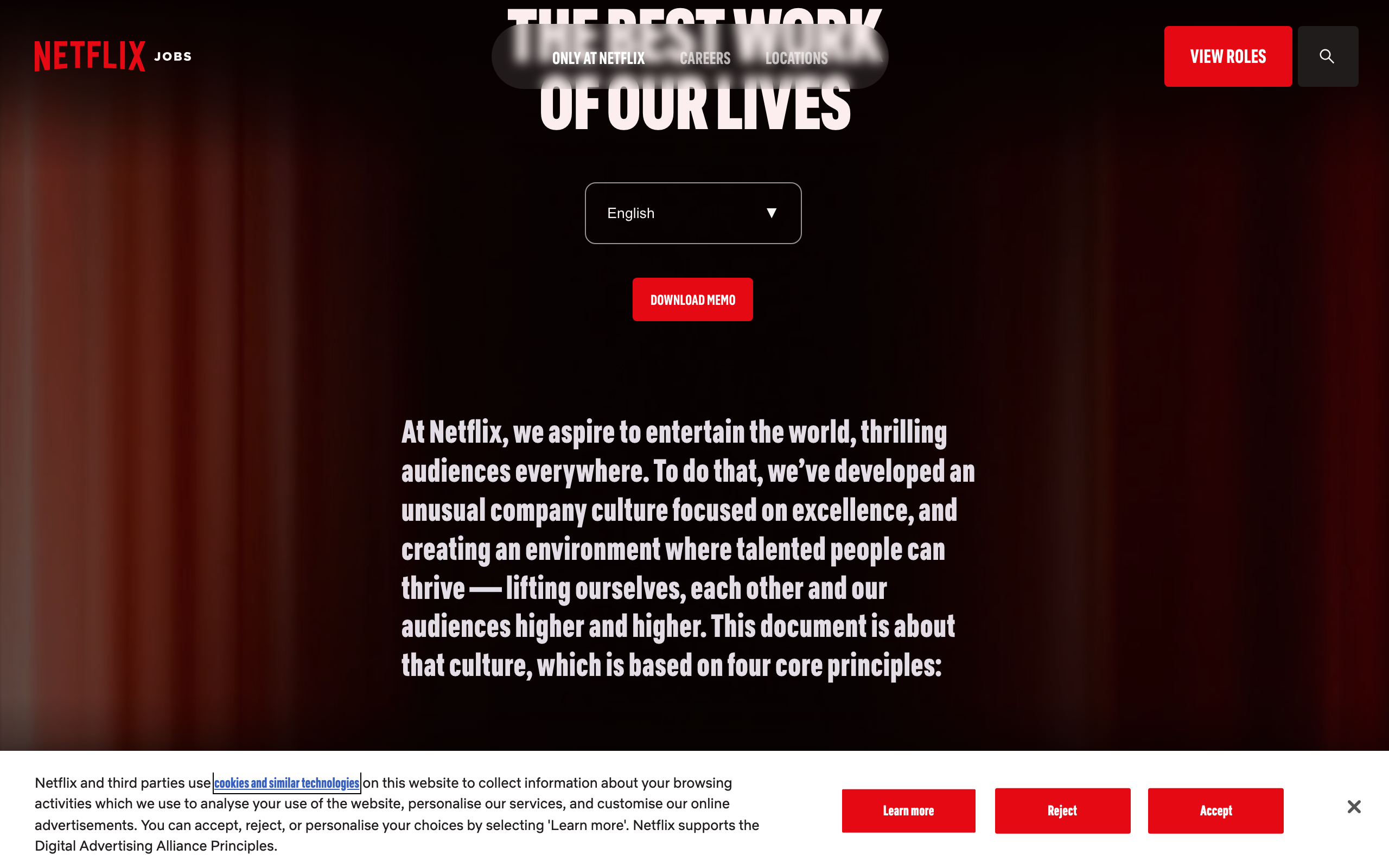
Netflix's culture page became one of the most influential HR documents ever published. Rather than listing hundreds of rules, Netflix focused on articulating core values and trusting employees to act accordingly. Their "Freedom and Responsibility" philosophy emphasizes high performance, honest feedback, and minimal bureaucracy.
The original culture deck was viewed over 20 million times on SlideShare and was described by Sheryl Sandberg as one of the most important documents to come out of Silicon Valley. What makes it remarkable is the specificity: Netflix doesn't just say "we value courage." They explain that courage means giving candid feedback to colleagues even when it's uncomfortable, and that silence is considered implicitly harmful.
What you can steal: Lead with values, not rules. When employees understand why a policy exists, compliance becomes intuitive rather than forced. But be honest: this approach requires extremely selective hiring and a tolerance for the discomfort that radical candor creates.
2. HubSpot
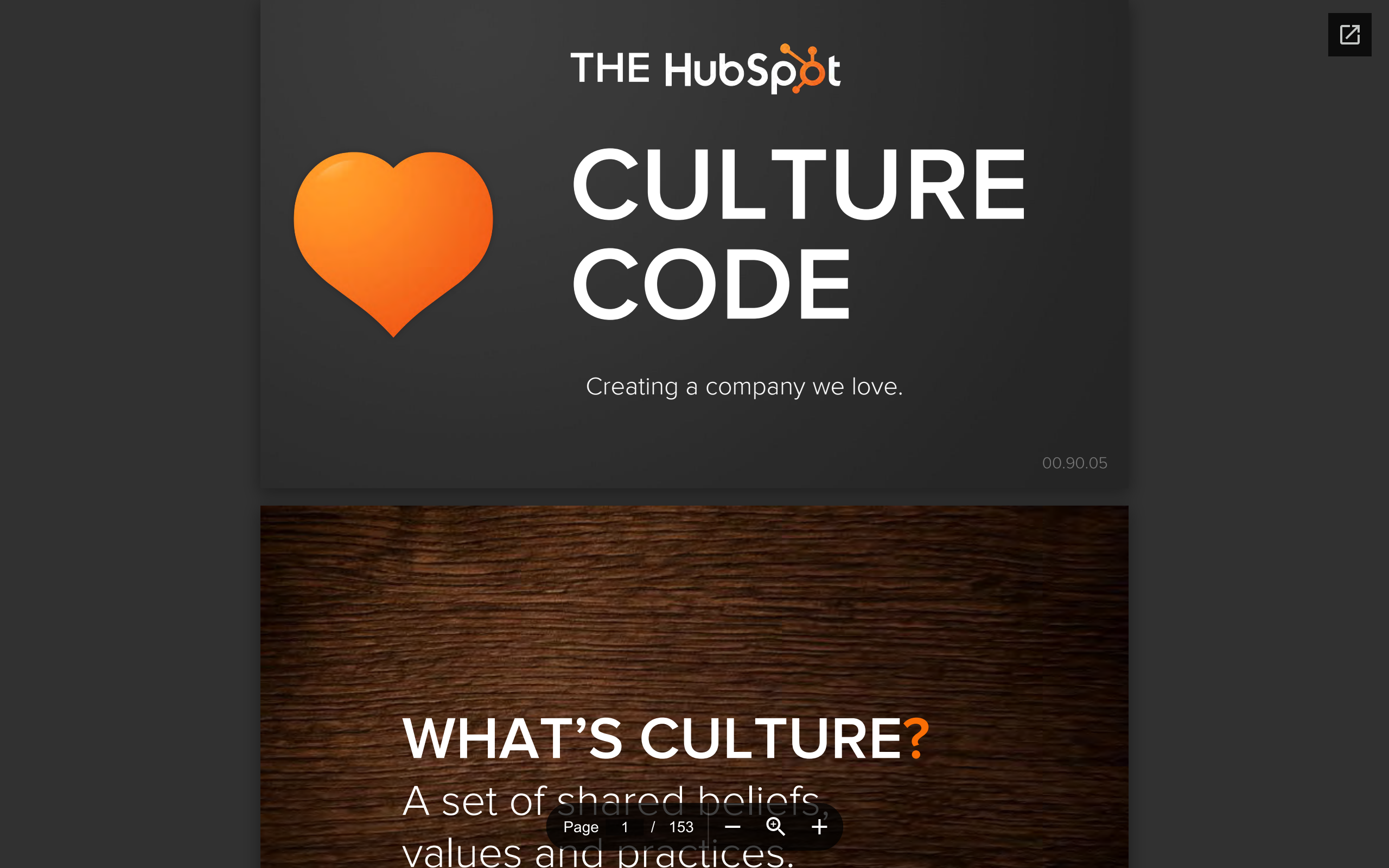
HubSpot published their Culture Code as a 128-page public slide deck that serves as both an internal handbook and an external recruiting tool. The document is refreshingly honest about what HubSpot values (autonomy, transparency, customer obsession) and what it explicitly doesn't (ego, bureaucracy, "brilliant jerks").
The genius of HubSpot's approach is the dual purpose. By making the Culture Code public, they attract candidates who already self-select for cultural fit. Prospective hires read the deck before applying and either think "this is exactly what I want" or "this isn't for me." That saves everyone time.
What you can steal: Making your handbook public forces you to be honest. If you'd be embarrassed by a candidate reading your handbook, that's a signal it doesn't reflect reality. Even if you don't publish the whole thing, consider making your culture and values sections publicly available.
3. Zappos

Zappos takes culture documentation further than almost any company. Beyond their standard employee handbook, they publish an annual "Culture Book" featuring unedited employee submissions about what the culture means to them. No corporate editing, no spin. If an employee wants to share something critical, it goes in.
The handbook itself is structured around Zappos' 10 core values, which drive everything from hiring decisions to customer service interactions. The values are specific enough to be actionable: "Create Fun and a Little Weirdness" isn't a typical corporate value, but it's unmistakably Zappos.
What you can steal: Incorporate real employee voices. Consider adding quotes, testimonials, or team descriptions written by actual employees alongside your formal policies. It creates authenticity that no amount of corporate writing can match, and it makes the handbook feel collaborative rather than top-down.
The Design-Forward Handbooks
These handbooks prove that how you present policies matters as much as the policies themselves. Visual design drives engagement and retention.
4. Valve

Valve's employee handbook is a 37-page illustrated guide that reads more like a graphic novel than a policy document. Hand-drawn illustrations break up every section, and the first-person plural writing style makes it feel like a conversation with a colleague rather than a directive from HR.
The content is just as distinctive as the design. Valve operates with a famously flat organizational structure, meaning no traditional managers and employees choose their own projects. The handbook explains how this actually works in practice: how to find a project, how to evaluate whether your work is valuable, and (candidly) what to do if you "screw up."
What you can steal: Tone matters enormously. If your company culture is creative and informal, your handbook should sound creative and informal. Also, invest in visual design. Headers, illustrations, and white space aren't decoration; they're the difference between a handbook employees read and one they skim past.
5. Facebook/Meta

Facebook's original employee handbook was designed with the quality of a coffee-table art book. Every page balanced text with carefully curated imagery, custom illustrations, and design elements that made it feel like a premium publication rather than a compliance document. The handbook was physically handed to new employees as part of their onboarding, and the production quality signaled that Facebook took its culture seriously enough to invest in how it was communicated.
What you can steal: Physical (or digital) design quality signals organizational values. When a handbook looks like someone cared about making it, employees notice. You don't need Facebook's budget to achieve this. Tools like AirMason's handbook builder let you create visually polished, branded handbooks with professional templates and drag-and-drop design.
6. The Motley Fool
The Motley Fool accomplishes something remarkably difficult: covering 30 policy topics in just 16 pages. Their handbook uses humor, casual language, and clever margin notes to keep employees engaged through what would otherwise be dry policy material. The tone is conversational without being unprofessional, and every policy is explained with enough context that employees understand the reasoning, not just the rule.
What you can steal: Brevity is a virtue. Every policy in your handbook should earn its place. If you can explain a policy in one paragraph instead of three, do it. The Motley Fool proves that concise doesn't mean incomplete; it means respectful of your employees' time.
The Radically Transparent Handbooks
These companies publish their handbooks for the entire world to see, and they welcome feedback from anyone.
7. GitLab
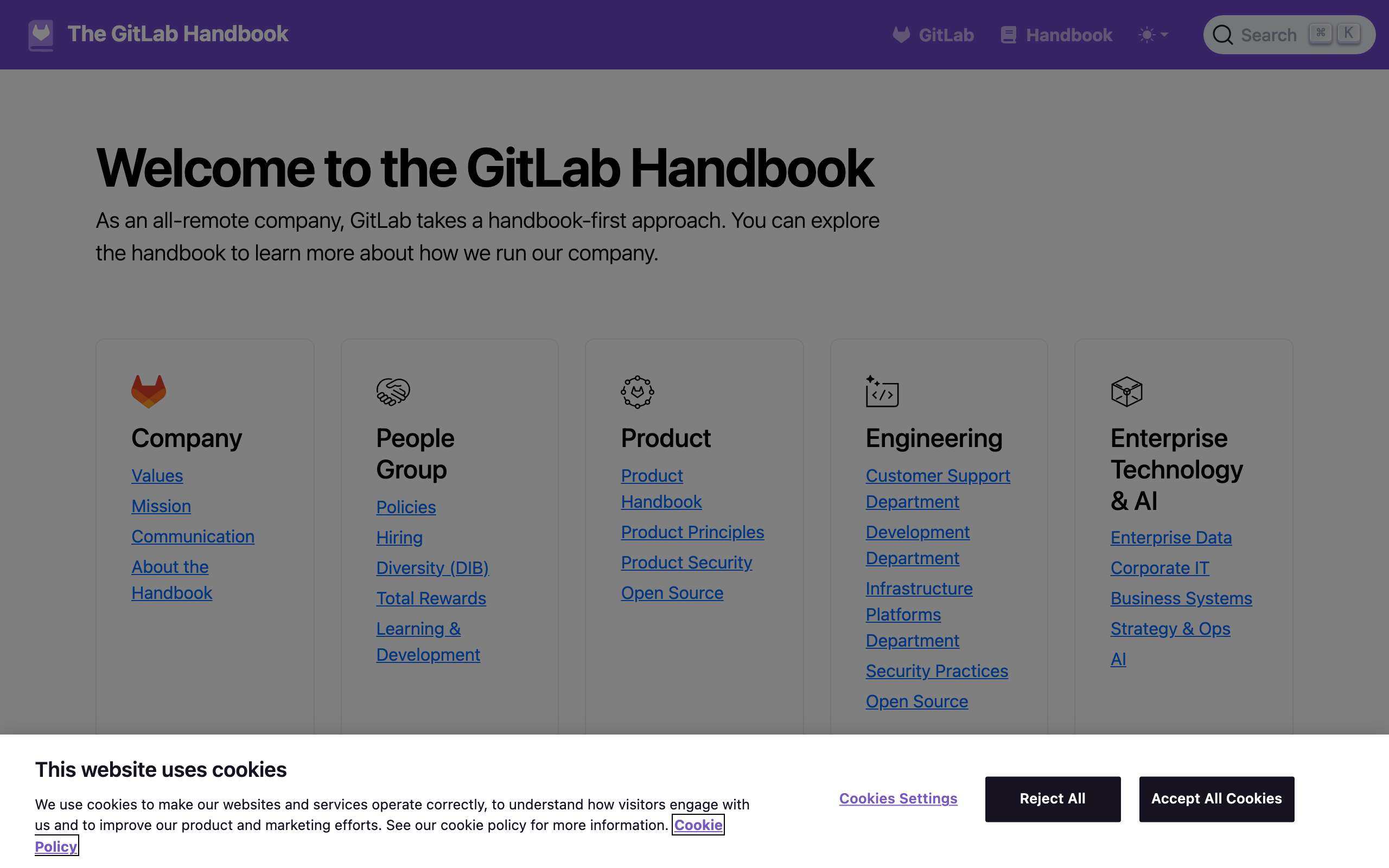
GitLab's public handbook is the most comprehensive corporate handbook ever created: over 13,800 pages covering virtually every aspect of how the company operates. From engineering workflows to expense policies to how they run meetings, it's all public. Anyone can suggest improvements through a "merge request" (GitLab's version of a pull request), and the "issues" feature lets anyone ask questions.
This radical transparency serves multiple purposes. It eliminates information asymmetry between teams, serves as documentation for remote employees across 65+ countries, and functions as a recruiting tool that demonstrates GitLab's commitment to openness.
What you can steal: While 13,800 pages is overkill for most organizations, the principle of making information accessible by default rather than restricting it is powerful. Consider which sections of your handbook could be public, and build a process for employees to suggest improvements rather than just receive directives.
8. Basecamp
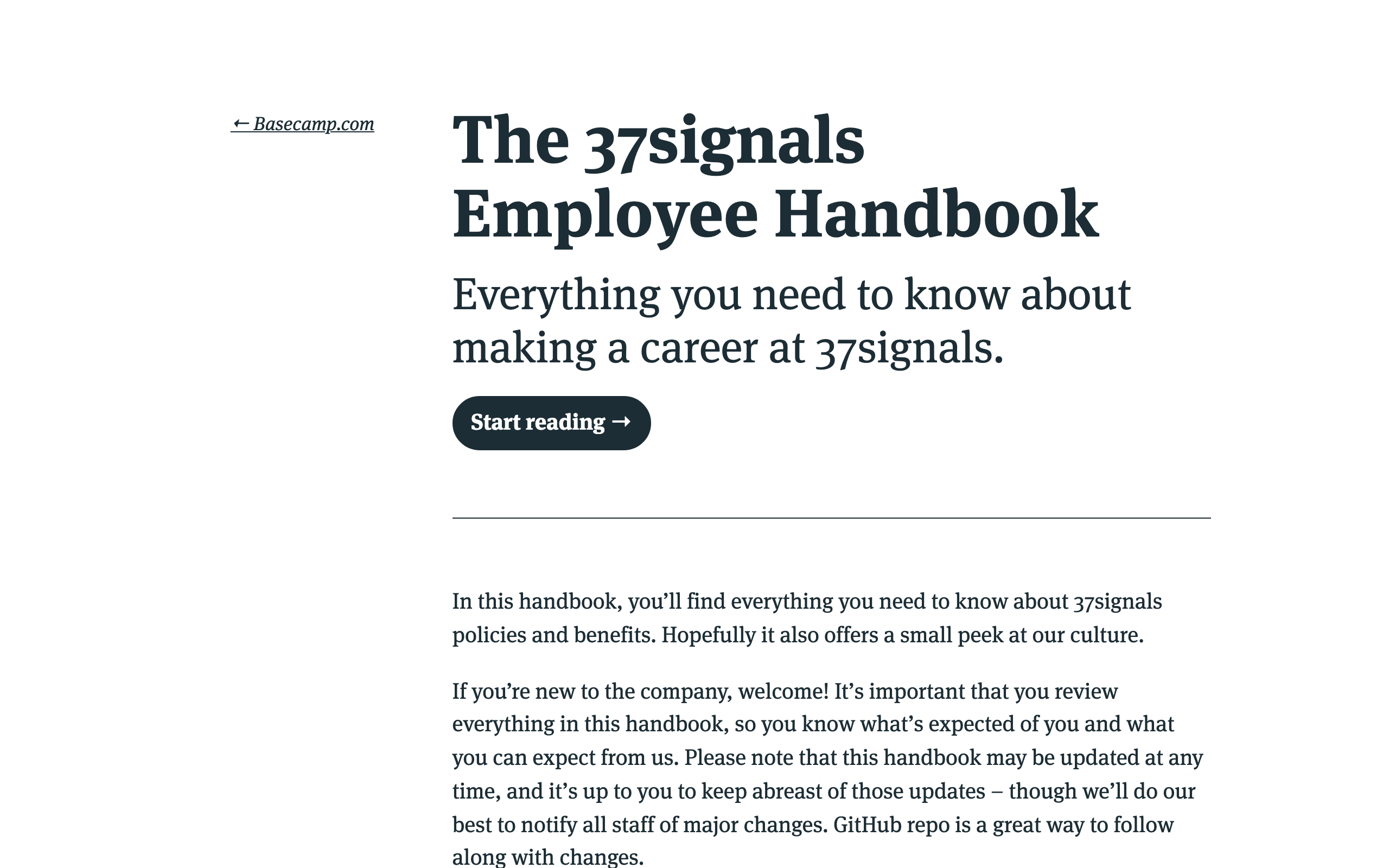
Basecamp (formerly 37signals) maintains a public employee handbook that reads like it was written by a human rather than a legal department. Short sentences, abundant headers, zero corporate jargon. The handbook covers everything from benefits to how they think about work-life balance, and every section is direct enough that you never wonder what they actually mean.
Basecamp is famously opinionated about how work should be done (no more than 40 hours a week, limited meetings, asynchronous communication first), and the handbook doesn't shy away from those opinions. It's a clear statement of how Basecamp operates, not a generic template.
What you can steal: Write your handbook the way your employees actually talk. Read every section out loud. If it sounds like a robot wrote it, rewrite it. Basecamp also demonstrates that having strong opinions in your handbook is a feature, not a bug. It helps potential hires self-select.
9. Human Made
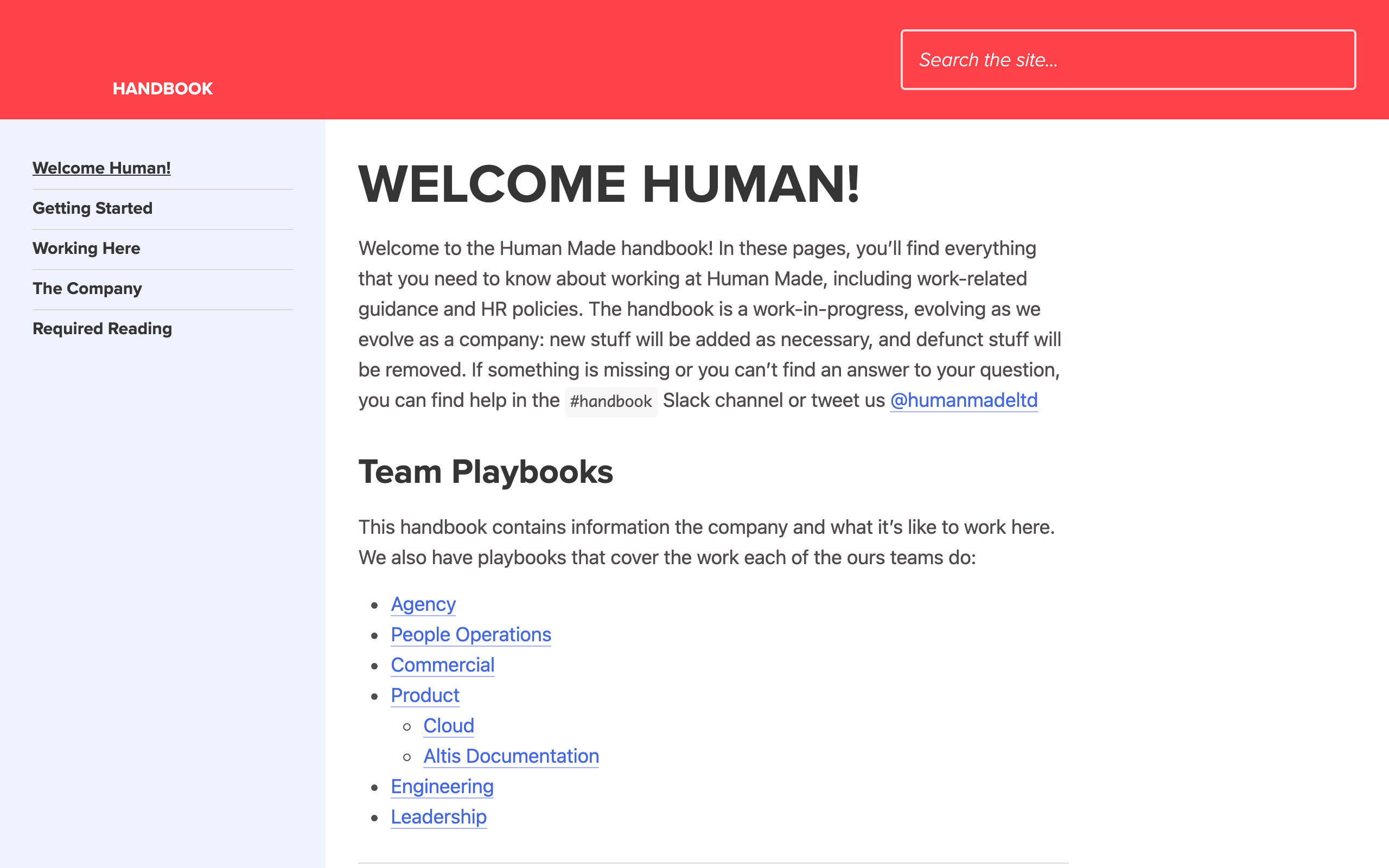
Human Made, a WordPress development agency, hosts their entire employee handbook as an open-source website. The handbook includes a search function, clean navigation, and is maintained by the team as a collaborative document. Updates are tracked through version control, just like their code.
What you can steal: A searchable, well-organized digital employee handbook is infinitely more useful than a static PDF. When employees can find the answer to "How do I request PTO?" in 10 seconds instead of scrolling through 50 pages, they actually use the handbook. Build yours on a platform that supports search, navigation, and easy updates.
The Interactive and Digital-First Handbooks
These handbooks embrace technology to create experiences that go beyond traditional documents.
10. Trello
Trello took the concept of "eat your own cooking" literally by building their employee handbook inside their own product. Each policy lives on a Trello card that can be updated independently, commented on by employees, and linked to related resources. New hires learn the tool while reading about company policies, making onboarding serve double duty.
The modular card-based format means updating a single policy doesn't require republishing the entire handbook. Need to update the parental leave policy? Change one card. Everything else stays untouched.
What you can steal: Your handbook doesn't have to be a static document. Interactive, modular formats let employees navigate directly to what they need. AirMason's handbook platform offers this kind of modularity through a purpose-built interface, with electronic signatures, version control, and compliance tracking that a project management tool can't provide.
11. Octopus Energy
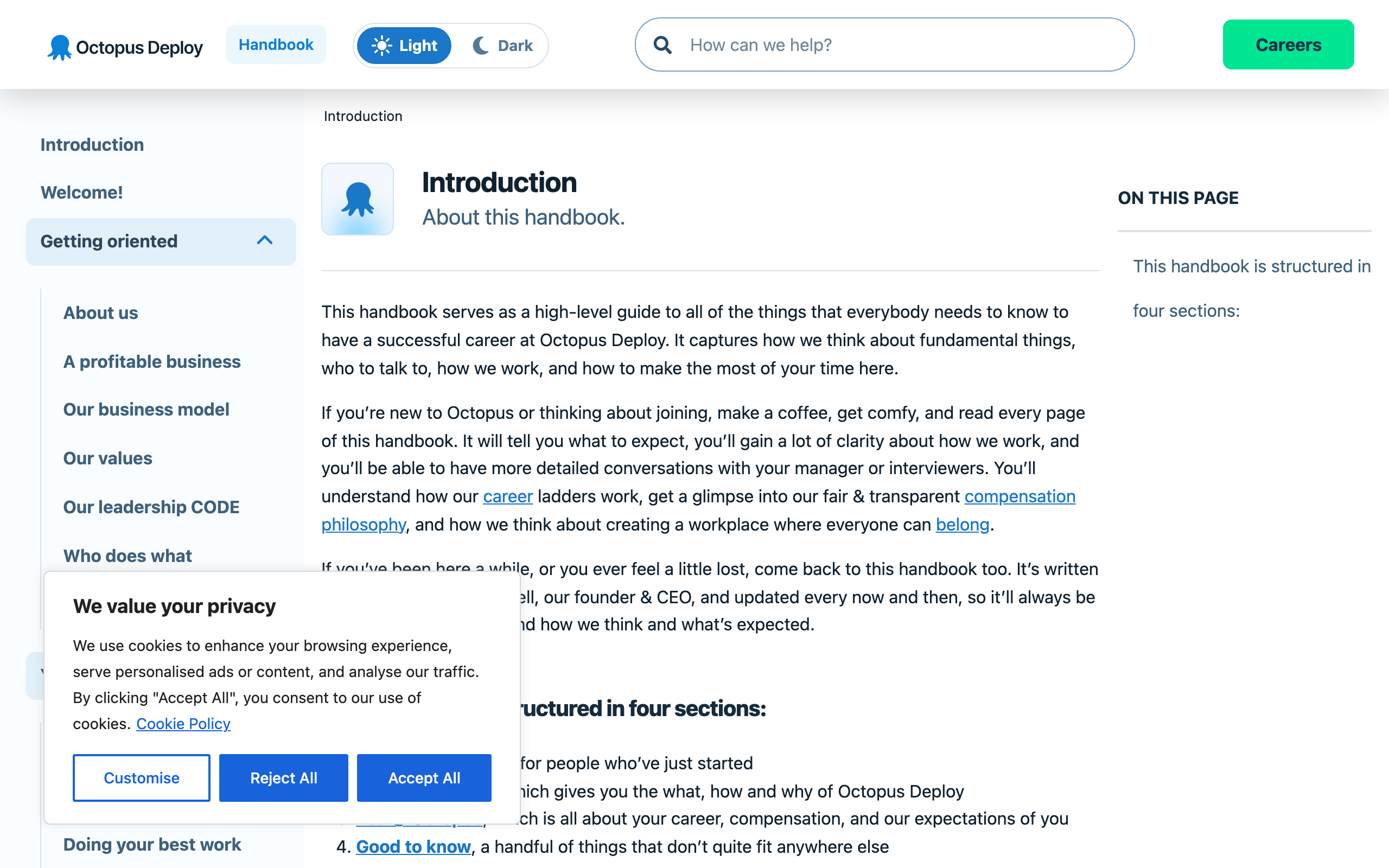
Octopus Energy publishes their employee handbook as a modern, web-based living document. The handbook is continuously updated and covers everything from leave policies to company principles. The web format makes it accessible from any device, and the clean design emphasizes readability over formality.
What you can steal: Treat your handbook as a living product, not a document you publish once and revisit annually. The best handbooks evolve with the company. Set up a quarterly review cadence at minimum, and use a platform that makes updates painless rather than requiring a full republication cycle.
12. Pronto Marketing
Pronto Marketing built their employee handbook as a clean, well-organized website optimized for quick comprehension. A clickable table of contents lets employees jump directly to any section, and the content is written in short, scannable paragraphs. They refer to team members as "Protons," reinforcing brand identity even in internal documentation.
What you can steal: Navigation is everything. If employees can't find what they're looking for in under 30 seconds, your handbook structure needs work. A clear table of contents, section anchors, and consistent formatting reduce the friction between having a question and finding the answer. For tips on structure, see our guide on crafting effective policy templates.
The Small Business and Startup Winners
You don't need a Fortune 500 budget to create a memorable handbook. These examples prove that small companies can punch above their weight. If you're a small business building your first handbook, these are the examples to study.
13. Nordstrom
Nordstrom's legendary handbook reportedly started as a single card that read: "Use good judgment in all situations." While the retailer's actual handbook is now more comprehensive (federal and state employment laws require documented policies), that origin story illustrates a timeless principle: the best policies empower employees to make decisions rather than controlling their behavior.
What you can steal: Simplicity has power. Every policy in your handbook should earn its spot. If you're including a rule because "we've always had it" rather than because it serves a clear purpose, cut it. The EEOC requires certain documented policies regardless of company philosophy, but beyond those legal minimums, less is often more.
14. Sterling

Sterling's employee handbook opens with a personal letter from the CEO, immediately establishing a human connection before diving into policies. The design is colorful, sleek, and modern, with policy information presented as accessible high-level summaries rather than dense legal text. A culture section and onboarding overview follow the CEO letter, meaning new hires understand the "who we are" before the "what you must do." Sterling built their handbook on the AirMason platform, which provides the professional design templates, digital distribution, and e-signature tracking that make the handbook both beautiful and functional.
What you can steal: Start with a human touch. A welcome message from leadership makes the handbook feel personal rather than institutional. It takes five minutes to write and fundamentally changes how employees experience the document.
15. Disney
Disney's original 1943 employee handbook featured cartoon iconography on every page, first-person language that made employees feel personally addressed, and minimal legalese. While this specific handbook is no longer in circulation, it remains a landmark example of how visual storytelling can transform a compliance document into something employees genuinely enjoy reading.
What you can steal: Visual elements aren't frivolous; they're functional. Even simple additions like branded headers, section icons, or company-specific illustrations make a handbook more engaging and more likely to be read. You don't need Disney's animation team. Modern design tools and templates put professional visual design within reach of any company.
What NOT to Do: Cautionary Examples
Not every handbook approach works. These cautionary tales highlight what happens when companies go too far in either direction.
Tesla's "Anti-Handbook Handbook"
Tesla published a 4-page "Anti-Handbook Handbook" for its 120,000+ employees. While the brevity was meant to signal trust and anti-bureaucracy, it left massive gaps in policy documentation. The company has faced multiple workplace discrimination lawsuits, and critics have connected the lack of comprehensive documented policies to these legal challenges. A Department of Labor-compliant handbook requires significantly more substance.
The lesson: There's a difference between simplicity and negligence. Nordstrom's one-rule story is inspiring, but in practice, companies need documented policies covering harassment, discrimination, safety, leave, and compensation. Brevity is great for tone; it's dangerous for compliance.
UBS: The 43-Page Dress Code
UBS, the Swiss banking giant, once published an employee handbook with a 43-page section dedicated solely to dress code. It covered everything from acceptable tie knots and scarf folds to guidance on undergarments, stockings, and posture. While thoroughness has its place, this level of specificity crosses into micromanagement and communicates a fundamental distrust of employee judgment.
The lesson: Policies should provide guardrails, not scripts. If your dress code policy is longer than your section on professional development, your priorities might need recalibrating.
Patterns from the Best: What They All Share
After analyzing all 15 examples, clear patterns emerge that separate exceptional handbooks from forgettable ones:
Culture before compliance. Every top-ranked handbook leads with values, mission, and culture before diving into policies. Employees need to understand why the company exists and how it operates before they can meaningfully engage with specific rules.
Written for humans, not lawyers. Legal accuracy matters, but legalese kills readability. According to SHRM's handbook guidance, readability at an 8th to 10th grade level significantly improves employee comprehension. The best handbooks translate complex policies into language employees actually understand.
Designed to be used, not just signed. The best handbooks function as living reference documents that employees return to. Search functionality, clear navigation, mobile accessibility, and visual design all determine whether your handbook gets used or ignored.
Regularly updated. Every company known for a great handbook treats it as a living document. Employment law changes constantly, and company policies evolve as organizations grow. The SHRM annual revision checklist is a useful resource for staying current.
Top Employee Handbook PDFs & Templates
Want something you can download and start editing today? We reviewed 20 freely available employee handbook PDFs and templates, scoring each on content depth, compliance coverage, and usability. Here are the top 5:
| # | Source | Score | Best For |
|---|---|---|---|
| ⭐ | AirMason Employee Handbook Template (2026) | 10/10 | Any business — all industries, all sizes |
| 2 | NFIB Model Employee Handbook (2025) | 9/10 | US small businesses of all types |
| 3 | Workable Employee Handbook Template | 8/10 | Startups & mid-size companies (10–200 employees) |
| 4 | MASC Municipal Model Employee Handbook | 8/10 | Municipalities, local government, public agencies |
| 5 | eForms Restaurant Employee Handbook | 7/10 | Restaurants, food service, hospitality |
See the full ranked list of 20 employee handbook PDFs and templates →
📥 Our #1 Pick: AirMason Employee Handbook Template
The AirMason template ranked first because it’s the only free handbook PDF that combines professional design, comprehensive policy coverage, and up-to-date 2026 compliance language — all in a single downloadable file. Download it here (PDF, 46 MB).
Want to go beyond PDF? AirMason’s platform lets you turn any handbook into a beautiful, digital experience employees can access on any device — with built-in tracking, e-signatures, and automatic updates.