Rhode Island Employee Handbook Requirements (2026)
Rhode Island has state-specific policies your employee handbook needs to address. Despite being the smallest state by area, Rhode Island packs significant employment law complexity, with a state-run paid family leave program that covers all employers, paid sick time requirements, equal pay rules that use a "comparable work" standard, and final pay penalties that can rise to felony level. Here's what employers need to get right. Please keep in mind requirements may vary based on company size, industry, location, and workforce composition.






At a Glance
Policy Breakdown by Category
Rhode Island requires 16 state-specific handbook policies. Here's what each one covers, without the legalese.
Leave
8 policiesWage & Hour
3 policiesCompliance
3 policiesBreaks
1 policyTermination Pay
1 policyNeed the Complete Rhode Island Addendum?
Get the full policy language for all 16 Rhode Island requirements, kept updated every week by our compliance team.
Talk to Our TeamCommon Compliance Pitfalls in Rhode Island
The mistakes we see most often, and how to avoid them.
Rhode Island's Temporary Disability Insurance (TDI) and Temporary Caregiver Insurance (TCI) programs are state-run, employee-funded, and mandatory for all employers with one or more employees. Unlike some states that allow private plan alternatives, Rhode Island provides no opt-out option. Every covered employer must participate in the state program.
For 2026, the employee contribution rate is 1.1% of wages on a taxable wage base of $100,000, resulting in a maximum annual employee contribution of $1,100. TCI provides up to 7 weeks of paid leave in 2025, increasing to 8 weeks in 2026. TDI provides up to 30 weeks of benefits for the employee's own disability.
Where employers create problems:
- Failing to deduct and remit. The employer is responsible for withholding TDI/TCI contributions from employee wages and submitting them quarterly to the Employer Tax Unit. Failing to deduct, deducting but not remitting, or remitting late all trigger penalties. The state treats this the same as failing to remit income tax withholding.
- Not posting the required notice. Employers must display the TDI/TCI Notice to All Employees poster in the workplace. This isn't optional, and the DLT checks for it during compliance audits.
- Retaliating against TCI users. Rhode Island law prohibits adverse action against employees who take TCI leave. Employers cannot terminate, demote, or reduce hours because an employee exercises TCI benefits. The job protection aspect is often overlooked by employers who focus only on the benefit payment.
- Not offering a comparable position upon return. When an employee returns from TCI leave, the employer must hold the employee's position or offer a comparable position with equivalent seniority, status, benefits, and pay. "We filled the position" is not a compliant response.
The increasing duration of TCI benefits (from 5 weeks when the program started to 8 weeks in 2026) means the operational impact grows each year. Employers need to plan for longer absences and stronger return-to-work obligations.
The fix: Verify that TDI/TCI deductions are configured at the correct 2026 rate (1.1% on $100,000 base). Submit quarterly reports on time. Post the required workplace notice. Document that employees who take TCI leave will have their position (or a comparable one) held. And train managers that TCI leave is protected leave, not voluntary absence.
Sources: RI DLT: TDI/TCI for Employers; RemoteLaws: Rhode Island Paid Leave 2026; The Hartford: Rhode Island TCI.
Rhode Island's Pay Equity Act uses a "comparable work" standard rather than the narrower "equal work" standard found in the federal Equal Pay Act. Comparable work is defined as work requiring substantially similar skill, effort, and responsibility performed under similar working conditions. This broader standard increases employer liability for pay disparities.
The law also bans salary history inquiries: employers cannot ask applicants about prior compensation and must provide wage ranges upon request. Pay transparency requirements apply to all employers.
The critical timing element:
- The civil penalty grace period expired December 31, 2024. During the grace period, employers had protection from civil fines while building compliance. Starting in 2025, any violation uncovered during a Rhode Island Department of Labor and Training (RIDLT) investigation can trigger fines of $1,000 to $5,000 per violation.
- The safe harbor provision runs through June 30, 2026. Employers who conduct a good-faith self-evaluation of their pay practices and correct any disparities within two years before a lawsuit is filed are protected from certain damages. After June 30, 2026, the safe harbor narrows: employers who self-correct may still be liable for unpaid wages even though they'd be protected from other damages.
- "Comparable work" casts a wider net. Two employees don't need identical job titles or duties. If a receptionist and an administrative assistant perform substantially similar work in terms of skill, effort, and responsibility, their pay must be comparable unless a legitimate factor (seniority, merit, education, experience) justifies the difference.
- Retaliation is independently actionable. Employees who inquire about, discuss, or disclose wages are protected from retaliation. An employer who disciplines an employee for asking a coworker about their pay has committed a separate violation.
The fix: Conduct a pay equity audit before the safe harbor narrows in June 2026. Document legitimate business reasons for any pay differences. Remove salary history questions from all applications and interview processes. Prepare wage range information that can be provided to applicants upon request. And train HR staff that the "comparable work" standard is broader than "equal work."
Sources: GoCo: RI Pay Transparency Guide; APS Law: RI Pay Equity; Littler: RI Pay Equity Law.
Rhode Island significantly escalated its final pay penalties starting January 1, 2024. Under the amended Payment of Wages Act (R.I. Gen. Laws Section 28-14-17), "knowing and willful" failure to pay wages of more than $1,500 is now a criminal felony, punishable by up to 3 years of imprisonment and a fine of up to $5,000.
The baseline rule is straightforward: final wages for both voluntary and involuntary terminations are due by the next regular payday. For business closures, mergers, or relocations, final pay must be issued within 24 hours.
What elevates this from a payroll nuisance to a criminal risk:
- The $1,500 felony threshold is low. For any salaried employee earning $39,000 or more per year, a single biweekly paycheck exceeds $1,500. Missing one final paycheck for one mid-level employee crosses the felony line. This isn't a threshold designed for large-scale wage theft; it catches routine payroll failures.
- "Knowing and willful" includes negligence patterns. An employer who has been informed of the obligation and repeatedly fails to pay on time can be deemed to have acted "knowingly." You don't need intent to defraud; a pattern of carelessness can meet the standard.
- Each pay period is a separate offense. If you miss the final paycheck deadline and also miss the subsequent payday, that's two separate violations. The penalties multiply quickly.
- Accrued vacation must be included. Employees with at least one year of service must receive payment for earned, unused vacation in their final paycheck. Forgetting to include vacation pay is a separate violation even if base wages are paid on time.
The 2024 amendment also makes an employer's agent or officer personally liable for felony charges if they fail to pay wages owed, including vacation pay, to separating employees. This means the HR director or CFO who signs off on late payments faces personal criminal exposure.
The fix: Build a final pay checklist that includes base wages, accrued vacation, commissions, and any other earned compensation. Process final pay on or before the next regular payday. For layoffs, closures, or relocations, have 24-hour final pay processing ready. And document your process so that any delay can be shown as inadvertent rather than willful.
Sources: Littler: RI Felony Wage Penalties; R.I. Gen. Laws Section 28-14-17; SixFifty: RI Employee Separation Guide.
Rhode Island's Healthy and Safe Families and Workplaces Act (Title 28, Chapter 57) creates a two-tier system: employers with 18 or more employees must provide paid sick and safe leave, while smaller employers must provide unpaid leave. Employees accrue 1 hour for every 35 hours worked, up to 40 hours per year.
Employers can choose to frontload the full 40 hours at the start of the year to avoid tracking accrual and carryover. Leave can be used for personal illness, family member care, domestic violence situations, and sexual assault-related needs.
The compliance traps:
- Miscounting at the 18-employee line. Part-time employees count toward the 18-employee threshold. A company with 12 full-time and 7 part-time employees has 19 employees for purposes of the Act and must provide paid leave. Counting only full-timers and concluding you have fewer than 18 is a common and expensive mistake.
- Not allowing "safe leave" usage. The "safe" in "sick and safe" means employees can use accrued leave for domestic violence, sexual assault, and stalking. A policy that restricts sick leave to health-related absences only violates the Act.
- Requiring excessive documentation. Employers may request medical certification for absences of three or more consecutive days, but not for shorter absences. Demanding a doctor's note for a single day out violates the law.
- Failing to maintain records. Employers must keep records of hours worked, leave accrued, and leave used for at least 3 years. If an employee files a complaint and you can't produce records, the DLT presumes in the employee's favor.
The RI Department of Labor and Training enforces compliance through complaint investigation. Employers who fail to provide required leave face back-pay liability for the leave that should have been provided, plus penalties determined by the DLT based on the severity, employer size, and whether the violation was willful.
The fix: Count all employees (full-time and part-time) to determine your tier. Configure accrual at 1 hour per 35 hours worked, or frontload 40 hours annually. Expand qualifying reasons to include domestic violence and stalking. Keep accrual and usage records for a minimum of 3 years. And train managers that documentation cannot be required for absences under 3 days.
Sources: RI DLT: Paid Sick and Safe Leave; R.I. Gen. Laws Section 28-57-6; DLT: HSFW Fact Sheet.
Rhode Island provides domestic violence leave through two separate mechanisms that employers must coordinate in their handbooks.
First: Crime Victim Court Leave (R.I. Gen. Laws Section 12-28-13). Employers with 50 or more employees must allow crime victims (including domestic violence victims) to take leave to attend court proceedings related to the crime. This leave may be unpaid, but the employee cannot be dismissed or demoted for exercising the right.
Second: Paid Sick and Safe Leave (Title 28, Chapter 57). For employers with 18 or more employees, paid sick leave can be used for needs arising from domestic violence, sexual assault, or stalking. This includes counseling, safety planning, relocating, and obtaining legal assistance. This is separate from the court leave right.
Where the coordination breaks down:
- Different employer size thresholds. A 30-person company must provide paid sick leave for DV-related needs but isn't required to provide the separate court leave. A 60-person company must provide both. Employers often address one and miss the other.
- Different types of coverage. Court leave covers attendance at legal proceedings. Sick and safe leave covers the broader range of DV-related needs (counseling, relocation, safety planning, medical treatment). These aren't interchangeable, and employees may need both.
- Confidentiality obligations. When an employee discloses domestic violence to access leave, that information is highly sensitive. Employers must limit access to this information and cannot share it with coworkers. Many managers are not trained on the confidentiality requirements.
- Documentation limits. For sick and safe leave used for DV purposes, the documentation rules are the same as for illness: no documentation required for absences under 3 days. For court leave, the employer can request proof of the court proceeding. But demanding extensive documentation about the DV situation itself risks deterring victims from using available leave.
The fix: Include both forms of DV-related leave in your handbook as separate provisions with clear eligibility criteria. Train managers on confidentiality requirements when employees disclose DV situations. Do not require documentation for short absences. And if you have 50+ employees, ensure your court leave policy specifically addresses crime victims including DV victims.
Sources: R.I. Gen. Laws Ch. 12-29: Domestic Violence Prevention Act; RI DLT: Paid Sick and Safe Leave; Paycor: DV Leave Laws by State.
Rhode Island Has 4 Employer Notice Requirements
Beyond handbook policies, Rhode Island employers must provide specific notices to employees for events like new hires, terminations, and qualifying events.
View Rhode Island Notice Requirements →Check Your Rhode Island Compliance in Minutes
Upload your handbook and get an instant compliance report, checked against 1,000+ rules including Rhode Island-specific requirements.
Try Our Free Employee Handbook Audit →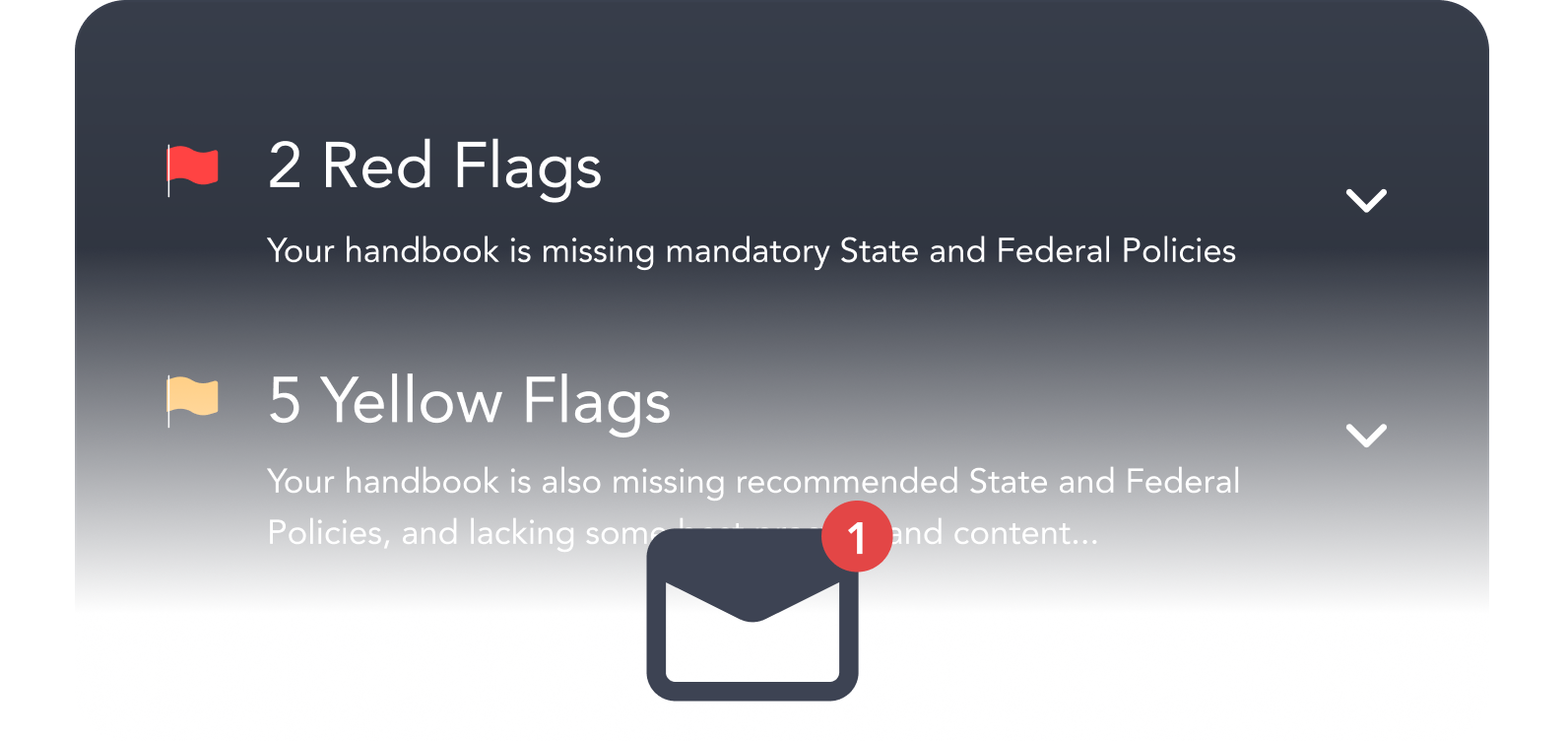
Understanding Rhode Island Employee Handbook Requirements
Rhode Island may be the smallest state, but its employment law framework is anything but small. With 16 state-specific policies, Rhode Island sits in the upper-middle tier of regulatory complexity for employee handbooks, driven largely by its pioneering state-run paid leave program and robust worker protections.
The 16 policies span five categories: Leave (8 policies, covering TDI, TCI, paid sick leave, parental leave, domestic violence leave, and more), Wage & Hour (3 policies on equal pay, minimum wage, and wage payment), Compliance (3 policies on pay transparency, anti-discrimination, and posting requirements), Breaks (1 policy on meal periods), and Termination Pay (1 policy with recently enhanced criminal penalties).
What distinguishes Rhode Island from other New England states is the breadth of its state-run programs. The TDI/TCI system covers all employers with even one employee, with no opt-out or private plan alternative. The paid sick leave law layers on top. And the equal pay statute uses a "comparable work" standard that's broader than federal law. The cumulative effect is a regulatory environment where small employers face obligations typically associated with much larger jurisdictions.
Rhode Island's TDI/TCI Programs: What Employers Must Know
Rhode Island was a pioneer in state-run paid leave, establishing its Temporary Disability Insurance program in 1942 and adding Temporary Caregiver Insurance in 2014. Both programs are funded entirely by employee payroll deductions (no employer contribution), but employers bear significant administrative obligations.
For 2026, the combined TDI/TCI contribution rate is 1.1% of wages on a taxable wage base of $100,000. That's a decrease from the 2025 rate of 1.3%, offset by the higher wage base (up from $89,200). TCI benefits increase to 8 weeks in 2026, up from 7 weeks in 2025.
Employer obligations include withholding the employee contribution from each paycheck, remitting the tax quarterly to the Employer Tax Unit, providing wage and employment reports when requested, displaying the Notice to All Employees poster, and not taking adverse action against employees who use TDI or TCI benefits.
The most important point for handbook drafting: TCI provides job protection. When an employee takes TCI leave, the employer must hold the employee's position or provide a comparable position upon return. This means TCI is not just a benefit program; it's a protected leave that carries reinstatement rights. Your handbook must reflect this, and managers must be trained that TCI absences are protected in the same way FMLA absences are protected for larger employers.
AirMason's handbook builder generates TDI/TCI policy language that covers the employee's rights, the employer's obligations, and the interaction with other leave programs.
Pay Equity and Transparency: Navigating Rhode Island's Evolving Requirements
Rhode Island's pay equity landscape has changed substantially since the Pay Equity Act took effect in 2023. The law uses a "comparable work" standard (broader than the federal "equal work" standard), bans salary history inquiries, and requires employers to provide wage range information to applicants upon request and for internal promotions.
The enforcement framework includes fines of $1,000 to $5,000 per violation, and the RIDLT has the authority to investigate complaints, audit pay practices, and impose penalties. The civil penalty grace period expired at the end of 2024, so violations discovered in 2025 and beyond are fully subject to fines.
The safe harbor provision is the most strategic element for employers. Through June 30, 2026, employers who conduct a good-faith pay equity audit and correct any disparities within two years before a lawsuit are protected from certain damages. After that date, the protection narrows. This creates a clear window of opportunity: conduct your audit now, fix any disparities, and document the process. Waiting until after the safe harbor narrows in mid-2026 means you lose the broader protection.
For handbook purposes, include language about your commitment to pay equity, the factors that drive compensation decisions (experience, education, performance, seniority), and the employee's right to discuss wages without retaliation. This documentation serves as evidence of your compliance posture if a claim is filed.
Keeping Your Rhode Island Handbook Current in 2026
Rhode Island's 2026 compliance calendar includes several changes that require handbook updates:
- TCI duration increase. TCI benefits expand from 7 weeks to 8 weeks starting January 1, 2026. Update your handbook's TCI section to reflect the new maximum duration.
- Contribution rate change. The TDI/TCI contribution rate decreases from 1.3% to 1.1%, but the wage base increases from $89,200 to $100,000. Update payroll configurations and any handbook references to contribution amounts.
- Pay equity safe harbor narrowing. The broader safe harbor expires June 30, 2026. If you haven't conducted a pay equity audit, the first half of 2026 is your last window to take advantage of the full protection. After July 1, self-correcting employers are still partially protected but face greater exposure.
- Final pay felony penalties. The 2024 amendments making willful wage theft a felony are now fully in effect. Review your termination and final pay processes to ensure compliance. The $1,500 threshold for felony charges is low enough to capture most professional employees' paychecks.
Rhode Island's legislative sessions have been active on employment law in recent years, and the trend is toward expanded protections and stronger penalties. Annual handbook reviews are essential, and monitoring RIDLT guidance throughout the year is advisable.
AirMason's handbook builder tracks Rhode Island law changes and pushes updates automatically. Run a free compliance audit to check your current handbook against all 16 Rhode Island requirements.
Frequently Asked Questions
Explore Other State Requirements
More Resources
Build a Compliant Rhode Island Employee Handbook
Expert-curated policies, updated weekly, built for how HR teams actually work.