Maryland Employee Handbook Requirements (2026)
Maryland has state-specific policies your employee handbook needs to address, with leave requirements dominating the landscape at 10 policies. The state's Healthy Working Families Act, a separate local sick leave law in Montgomery County, expanding non-compete restrictions, and one of the newest wage transparency laws create overlapping compliance obligations that catch multi-state employers off guard. Here's what you need to know. Please keep in mind requirements may vary based on company size, industry, location, and workforce composition.






At a Glance
Policy Breakdown by Category
Maryland requires 17 state-specific handbook policies. Here's what each one covers, without the legalese.
Leave
10 policiesWage & Hour
3 policiesCompliance
2 policiesBreaks
1 policyTermination Pay
1 policyNeed the Complete Maryland Addendum?
Get the full policy language for all 17 Maryland requirements, kept updated every week by our compliance team.
Talk to Our TeamCommon Compliance Pitfalls in Maryland
The mistakes we see most often, and how to avoid them.
Maryland's Healthy Working Families Act (Title 3, Subtitle 13 of the Labor and Employment Article) requires employers with 15 or more employees to provide paid sick and safe leave, and employers with fewer than 15 to provide unpaid sick and safe leave. Employees accrue 1 hour for every 30 hours worked, up to 40 hours per year, with carryover of up to 40 hours.
The penalty structure is what makes non-compliance expensive: up to $1,000 per employee for each employee the employer is not in compliance with, plus the full monetary value of the unpaid leave, actual economic damages, and if the employee prevails in court, 3x the value of the unpaid leave, punitive damages, and attorney's fees.
Where employers go wrong:
- Counting employees incorrectly at the 15-person threshold. The paid vs. unpaid distinction hinges on having 15 or more employees. Part-time employees, temporary employees, and employees on leave all count toward this threshold. An employer that counts only full-time employees and comes up with 14 may actually have 18 when all workers are included.
- Restricting usage to illness only. The Act covers "safe" leave as well as sick leave. Employees can use accrued leave for domestic violence, sexual assault, or stalking situations affecting themselves or family members. A policy that limits sick leave to personal illness is non-compliant.
- Not providing the required notice. Employers must post the Maryland Earned Sick and Safe Leave notice (available from the Maryland Department of Labor) in a conspicuous workplace location and provide written notice to employees at hire. Missing either requirement is a separate violation.
- Requiring a doctor's note for short absences. Maryland employers may only require verification for absences exceeding two consecutive scheduled shifts. Demanding documentation for a single sick day violates the Act.
For a 50-person company that hasn't been tracking accrual correctly, the worst case involves $50,000 in per-employee penalties, back-pay for the unpaid leave, and treble damages if employees file suit. The numbers add up quickly.
The fix: Count all employees (including part-time and temporary) against the 15-person threshold. Configure your leave system to accrue at the statutory rate. Expand qualifying reasons to include "safe leave" uses. Post the required notice and include it in your new-hire materials. And don't request medical documentation for absences of two shifts or fewer.
Sources: Maryland Dept. of Labor: Sick and Safe Leave; HWFA FAQs; HWFA Enforcement Guidance.
Montgomery County enacted its own Earned Sick and Safe Leave Law in 2016, before the state passed the Healthy Working Families Act. Because the state law only preempts local laws enacted on or after January 1, 2017, Montgomery County's earlier law survives. Employers with workers in the county must comply with both laws simultaneously, applying whichever provision is more generous to the employee.
Key differences that create compliance headaches:
- Employer size threshold. The state law requires paid leave at 15+ employees. Montgomery County requires paid leave for employers with 5+ employees. The county requires unpaid leave for employers with fewer than 5. A 7-person company in Bethesda must provide paid sick leave under county law even though state law would only require unpaid leave.
- Annual accrual cap. Montgomery County allows accrual of up to 56 hours per year, compared to the state's 40-hour cap. Employers operating in the county must use the higher 56-hour figure.
- Coverage of all employers. The County law applies to any employer with one or more employees working in Montgomery County. There is no exemption for employers based outside the county if work is performed within county limits.
- Enforcement through the County Office of Human Rights. Complaints under the county law are filed separately from state complaints, through the Montgomery County Office of Human Rights. Penalties include fines of up to $500 per violation, plus lost wages, compensatory damages, and attorney's fees.
The practical burden is a dual-tracking requirement. Employers with employees in both Montgomery County and other parts of Maryland may need to maintain two different accrual rates and caps, or simply adopt the more generous Montgomery County standard statewide to simplify administration.
The fix: If you have any employees who work in Montgomery County (including remote workers who reside there), apply the county's 56-hour accrual cap and the 5-employee paid leave threshold. Consider adopting the Montgomery County standard company-wide to avoid dual tracking. File awareness of both the state and county complaint processes.
Sources: Montgomery County OHR: Employer Guidance; People's Law Library: Montgomery County ESSL; Maryland DoL: State Preemption FAQ.
Maryland has been tightening non-compete restrictions on two fronts. First, the existing income-based restriction: non-competes are void and unenforceable for employees earning 150% or less of the state minimum wage, which currently works out to $22.50 per hour or less (based on the $15.00/hr minimum wage).
Second, and more recently, Maryland enacted a broad ban on non-competes for healthcare professionals effective July 1, 2025. For any employee licensed under the Maryland Health Occupations Article who provides direct patient care and earns total annual compensation of $350,000 or less, non-compete and conflict-of-interest provisions are banned entirely. For those earning above $350,000, non-competes are capped at one year and a 10-mile geographic radius from the primary place of employment.
Where employers create risk:
- Using old template agreements. If your standard employment agreement includes a non-compete clause and you haven't updated it since mid-2025, it's likely unenforceable for healthcare workers and low-wage employees. Continuing to present void agreements to new hires creates a bad-faith impression and potential claims.
- Forgetting the veterinary expansion. Maryland also banned non-competes for veterinarians and veterinary technicians, regardless of compensation level. This catches veterinary practice owners who have historically relied on non-competes to protect their patient base.
- Confusing non-competes with other restrictive covenants. The healthcare ban explicitly does not apply to nondisclosure agreements, confidentiality agreements, or non-solicitation agreements. Employers can still protect proprietary client information. But the restriction on direct competitive activity is gone for covered employees.
- Retroactivity misconceptions. The July 2025 law applies only to agreements executed on or after the effective date. Pre-existing non-competes remain enforceable under prior law. But employers cannot renew, extend, or modify old agreements to circumvent the new restrictions.
The fix: Audit all employment agreements for non-compete clauses. Remove or revise non-competes for employees earning $22.50/hr or less. For healthcare and veterinary workers, eliminate non-competes for those earning $350K or less and narrow the scope for higher earners. Shift your protective strategy toward enforceable alternatives like NDAs and non-solicitation agreements.
Sources: Fisher Phillips: Maryland Healthcare Non-Compete Ban; Tydings: Non-Competes in 2025; Lipp Law: Maryland Non-Compete Landscape.
Maryland's Equal Pay for Equal Work Act underwent a significant expansion effective October 1, 2024. The changes hit three areas simultaneously: expanded protected classes, mandatory salary range disclosure, and a pay history inquiry ban.
Protected classes. Maryland now explicitly prohibits pay differences based on sex, gender identity, and sexual orientation for comparable work. The prior law covered sex-based pay differences; the amendment makes the gender identity and sexual orientation protections explicit rather than implied.
Wage transparency. Under SB 525/HB 649, all employers must include a minimum and maximum salary range in every job posting for positions that will be physically performed, at least in part, within Maryland. This applies to both external and internal postings.
Pay history ban. Employers may not request or require salary history from applicants as a condition of employment, and they cannot use salary history information to determine wages unless the applicant voluntarily provides it.
Where the pitfalls are:
- Job postings on national platforms. A LinkedIn posting for a role that could be performed in Maryland must include the salary range, even if the company is headquartered elsewhere. The obligation follows the job location.
- Using "comparable work" defensively. The Act uses "comparable work" rather than "equal work" to define the comparison standard. This means employers can't avoid scrutiny by giving slightly different job titles to employees performing substantially similar work.
- Retaliation for pay discussions. Employees have the right to inquire about, discuss, and disclose their wages. Employers who take adverse action against employees for wage discussions face enforcement by the Maryland Department of Labor, including penalties of up to $500 per employee per violation.
The fix: Add salary ranges to all job postings for Maryland-based roles. Remove salary history questions from applications and interview protocols. Review compensation across comparable roles for gender identity and sexual orientation pay gaps. Document legitimate business reasons for any pay differences in case of audit.
Sources: Ogletree: Maryland Wage Transparency Law; Venable: Maryland 2024 Legislative Session; Fisher Phillips: Maryland Pay Equity.
Maryland's Flexible Leave Act applies to employers with 15 or more employees who provide any form of leave with pay (sick leave, vacation, PTO, comp time). The Act requires that if you provide paid leave, employees must be allowed to use it to care for an ill immediate family member (child, spouse, or parent) and for bereavement upon the death of an immediate family member, under the same terms they could use leave for their own purposes.
This sounds simple, but it creates a stacking effect that many employers don't anticipate:
- Sick leave policies that restrict usage to "employee's own illness." If your policy provides 10 days of paid sick leave but limits it to the employee's personal illness, the Flexible Leave Act overrides that restriction. The employee can use those same 10 days to care for a sick child, spouse, or parent.
- PTO policies with narrow categories. Even if your PTO policy doesn't label any bucket as "sick leave," any paid leave that can be used for the employee's own illness must also be available for family illness and bereavement. The Act looks at function, not labels.
- Bereavement leave as a separate, limited benefit. If your policy provides 3 days of bereavement leave but 10 days of PTO, an employee can use PTO for additional bereavement time under the same conditions they would use PTO for their own needs. The Flexible Leave Act effectively expands bereavement coverage to the full extent of available paid leave.
- Retaliation protections. Employers cannot discharge, demote, suspend, discipline, or threaten employees for exercising their rights under the Act. This includes penalizing employees for using sick days to care for family members, even if it was previously against company policy.
The Flexible Leave Act interacts with the Healthy Working Families Act and (starting July 2026) the Time to Care Act, creating yet another layer of leave obligations that must be coordinated in your handbook.
The fix: Review your leave policy language to ensure paid leave is available for family illness and bereavement, not just employee illness. Remove any restriction that limits sick leave to the employee's own health conditions. Train managers that denying leave for family care purposes when the employee has available paid leave is a violation.
Sources: Labor Law Center: Maryland Flexible Leave Act; Gordon Feinblatt: Maryland's Flexible Leave Law; Maryland DoL: Employment Standards Guide.
Maryland Has 4 Employer Notice Requirements
Beyond handbook policies, Maryland employers must provide specific notices to employees for events like new hires, terminations, and qualifying events.
View Maryland Notice Requirements →Check Your Maryland Compliance in Minutes
Upload your handbook and get an instant compliance report, checked against 1,000+ rules including Maryland-specific requirements.
Try Our Free Employee Handbook Audit →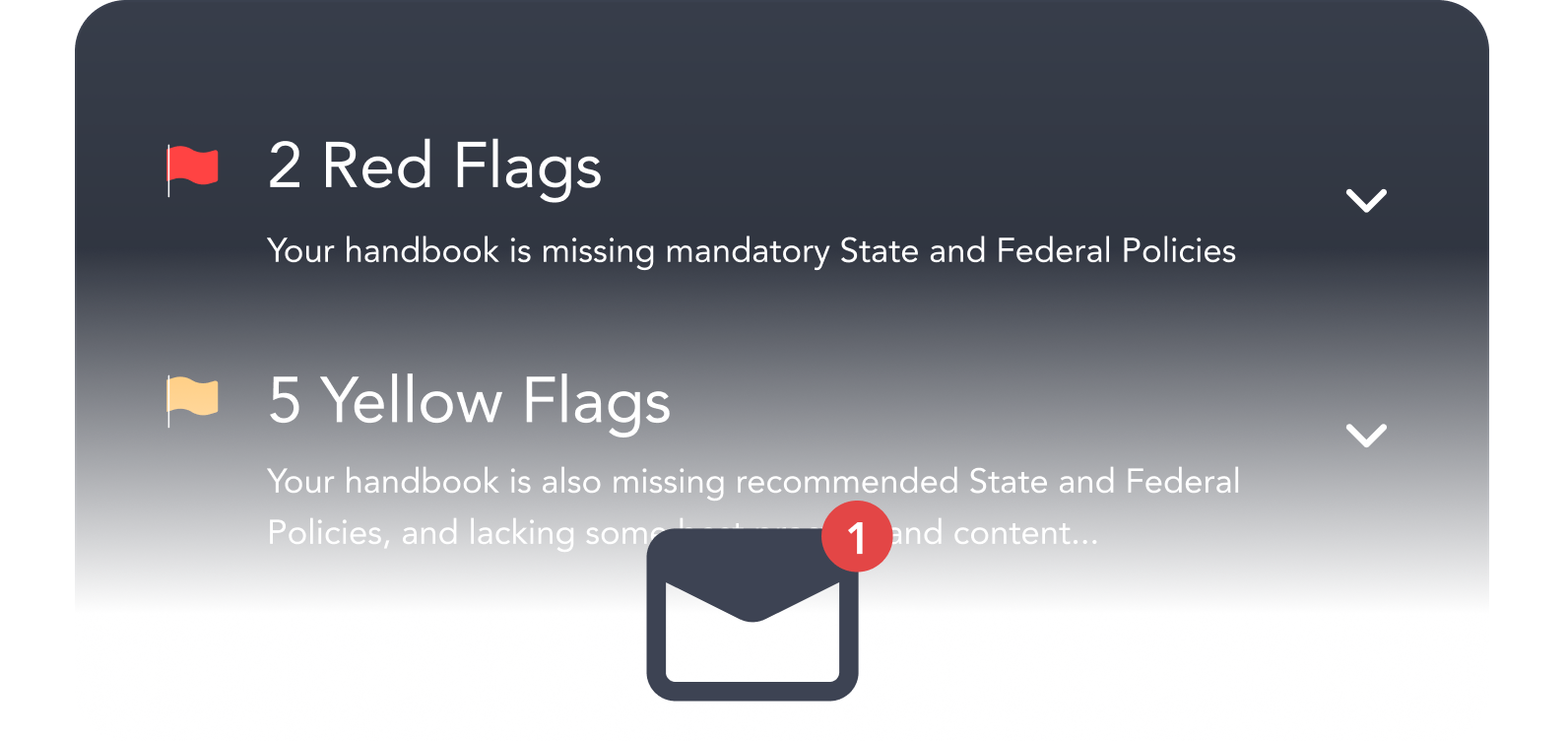
Understanding Maryland Employee Handbook Requirements
Maryland sits squarely in the mid-Atlantic regulatory belt where state employment law significantly expands federal protections. With 17 state-specific policies, Maryland is not as complex as California or New York, but it's far from a hands-off jurisdiction. The state's distinctive feature is the sheer density of its leave requirements: 10 of the 17 policies fall into the Leave category.
Those 17 policies span five categories: Leave (10 policies, including the Healthy Working Families Act, the Flexible Leave Act, and the upcoming Time to Care Act), Wage & Hour (3 policies covering equal pay, minimum wage, and wage payment), Compliance (2 policies on non-compete restrictions and anti-discrimination), Breaks (1 policy for retail employees), and Termination Pay (1 policy on final paycheck timing).
The layered nature of Maryland's leave requirements is the primary compliance challenge. The Healthy Working Families Act provides the base sick and safe leave. The Flexible Leave Act expands how that leave can be used. Montgomery County adds a separate, more generous local requirement. And the Time to Care Act, launching in July 2026, will add a state-run paid family and medical leave insurance program on top of everything else.
For employers operating in Maryland, the question is not whether you need a handbook. It's whether your handbook accurately reflects the interactions between all these overlapping leave programs. An outdated or overly simplified leave policy is the fastest path to an employee complaint.
Maryland's Paid Leave Landscape: What Changes in 2026
Maryland's paid leave framework is about to get significantly more complex. The Time to Care Act (Maryland's FAMLI program) is scheduled to begin collecting contributions in July 2025 and paying benefits starting July 1, 2026. When it launches, it will add a state-run paid family and medical leave insurance program to the existing stack of leave requirements.
The program will provide up to 12 weeks of paid leave per year (or up to 24 weeks when combining family and medical leave), with benefits replacing a portion of the employee's wages. Contributions will be shared between employers and employees, similar to DC's Universal Paid Leave structure but with different rates and eligibility rules.
For handbook purposes, the practical challenge is coordination. Starting in mid-2026, a Maryland employee dealing with a serious illness could simultaneously be covered by the Time to Care Act (paid benefits), the Healthy Working Families Act (accrued sick leave), federal FMLA (unpaid job protection for employers with 50+ employees), and the Flexible Leave Act (allowing use of other paid leave for family care). Your handbook needs to explain how these programs interact without creating contradictions.
The Maryland Department of Labor has been releasing implementation guidance throughout 2025, and employers should monitor the FAMLI portal for updates on contribution rates, filing requirements, and benefit calculations. AirMason's handbook builder will generate Time to Care Act language as the program details are finalized.
Wage Equity and Transparency: Maryland's New Requirements
Maryland's wage equity framework underwent a significant overhaul in 2024. The Equal Pay for Equal Work Act now explicitly protects against pay differences based on gender identity and sexual orientation, in addition to the existing sex-based protections. And the new wage transparency requirements that took effect October 1, 2024 require salary ranges in all job postings.
The "comparable work" standard is particularly important for Maryland employers to understand. Unlike the federal Equal Pay Act, which requires "equal work," Maryland uses "comparable work," which is defined as work requiring substantially similar skill, effort, and responsibility performed under similar working conditions. This broader standard means employees don't need to prove their jobs are identical to a comparator's; they only need to show the jobs are substantially similar.
For handbook purposes, this means your compensation philosophy section needs to address how pay decisions are made and what factors (experience, education, performance, seniority) legitimately drive pay differences. If your handbook is silent on compensation methodology, you're leaving yourself exposed in any equal pay challenge, because you'll have no documented basis for pay decisions.
The pay history ban adds another dimension. Employers cannot ask applicants about prior compensation and cannot use salary history to set pay. If your application forms or interview guides still include salary history questions, they need to be updated immediately. The Maryland Department of Labor enforces these provisions and can impose fines of up to $500 per employee per violation.
Keeping Your Maryland Handbook Current in 2026
Maryland's employment law calendar for 2026 is packed. Here are the updates that require handbook attention:
- Time to Care Act launch (July 2026). Benefits begin mid-year. Your handbook needs a new section explaining the program, employee eligibility, how to file claims, and how the program interacts with existing leave policies. Contribution deductions from employee pay must begin as scheduled.
- Healthcare non-compete ban (effective July 1, 2025). If you haven't already updated employment agreements for healthcare and veterinary workers, this is overdue. Remove or revise non-compete clauses for covered employees.
- Wage transparency enforcement. The October 2024 salary range posting requirement is now fully in effect. If you're still posting jobs without ranges, every non-compliant posting is a potential violation.
- Montgomery County coordination. Montgomery County's sick leave law continues to operate alongside state law. Employers with any workers in the county should ensure they're applying the more generous county standard (56-hour cap, 5-employee paid leave threshold).
- Minimum wage inflation adjustment. Maryland's $15.00/hr minimum wage is subject to annual inflation adjustments starting in 2025. Check the current rate and update your handbook and payroll accordingly.
Maryland's legislative approach has been to add protections steadily rather than in large omnibus bills. This means the changes come frequently and in smaller increments that are easy to miss. Annual handbook reviews are the baseline; semi-annual reviews are better given the mid-year launch of the Time to Care Act.
AirMason's handbook builder tracks Maryland law changes and generates compliant policy language as requirements take effect. Run a free audit to see where your current handbook stands against all 17 Maryland requirements.
Frequently Asked Questions
Explore Other State Requirements
More Resources
Build a Compliant Maryland Employee Handbook
Expert-curated policies, updated weekly, built for how HR teams actually work.