Louisiana Employee Handbook Requirements (2026)
Louisiana keeps its state employment law footprint small, but the laws it does have carry real teeth. Final pay penalties can reach 90 days of wages, and the Smoke-Free Air Act applies to every enclosed workplace. Here is what your handbook needs to cover and where employers typically trip up. Please keep in mind requirements may vary based on company size, industry, location, and workforce composition.






At a Glance
Policy Breakdown by Category
Louisiana requires 5 state-specific handbook policies. Here's what each one covers, without the legalese.
Leave
1 policyWage & Hour
2 policiesCompliance
1 policyTermination Pay
1 policyNeed the Complete Louisiana Addendum?
Get the full policy language for all 5 Louisiana requirements, kept updated every week by our compliance team.
Talk to Our TeamCommon Compliance Pitfalls in Louisiana
The mistakes we see most often, and how to avoid them.
Under RS 23:631, when an employer discharges an employee, all amounts due must be paid by the next regular payday or within 15 days of discharge, whichever comes first. The same timeline applies when an employee resigns. Sounds reasonable. The penalty for missing it is not.
An employer who fails to pay on time is liable for up to 90 days of wages at the employee's daily rate of pay, or full wages from the date the employee demands payment until the employer actually pays, whichever is less. For a worker earning $50,000/year, that 90-day penalty cap works out to roughly $12,329 on top of the wages owed.
The penalty applies automatically once the employee makes a demand for payment and the employer fails to deliver within the statutory window. Courts have consistently held that good-faith disputes over the amount owed do not excuse the employer from the timing requirement. You can dispute the total while still paying the undisputed portion on time.
Accrued vacation pay adds another layer. Louisiana courts treat vacation pay earned under a written or oral employer policy as a wage. If your company policy provides paid vacation, that accrued balance must be included in the final payment. Forfeiture clauses do not override this.
The fix: Pre-calculate final pay before any planned termination. Include accrued vacation if your policy provides it. Have off-cycle payroll capability ready. Do not wait for the next regular pay cycle when a departing employee demands immediate payment.
Sources: La. RS 23:631; RS 23:631 (Justia).
RS 23:635 contains a simple rule that Louisiana employers violate with surprising frequency: you cannot assess fines against employees or deduct fines from their wages.
The most common violations happen in restaurant and retail settings. Deducting from a server's pay for a walkout tab, docking a cashier for a register shortage, or withholding wages because an employee damaged merchandise without a conviction or guilty plea for theft are all potential violations of this statute.
The exceptions are narrow. Employers can recover deductions for willful or negligent damage to employer property, and for cases where the employee has been convicted of or pled guilty to theft of employer funds. But the amount deducted cannot exceed the actual damage done. Rounding up or adding a "processing fee" to a damage deduction violates the statute.
There is also a deposit provision: employers may require a cash deposit to guarantee return of equipment, but they must pay the employee at least 4% annual interest on that deposit. Most employers who collect equipment deposits do not pay interest, putting them in technical violation.
The fix: Audit your payroll deduction practices. If you deduct for damages, make sure there is written documentation and the amount matches the actual loss. Do not deduct for register shortages unless you can tie it to willful or negligent conduct. If you collect equipment deposits, set up an interest calculation.
Sources: La. RS 23:635; RS 23:635 (FindLaw).
The Louisiana Smoke-Free Air Act (RS 40:1291.11 et seq.) prohibits smoking in all enclosed areas of workplaces, regardless of how many employees you have. Even a business with a single employee must ban indoor smoking.
Where employers get into trouble:
- Missing the signage requirement. Employers must post conspicuous "No Smoking" signs at every entrance. The signs must be clearly visible. Failing to post signs is a separate violation from allowing smoking.
- Assuming exemptions that do not apply. While bars and gaming facilities had historical exemptions, the law has been tightened over time. Verify your specific exemption status rather than assuming it.
- Retaliating against complainants. The Act explicitly prohibits employers from discriminating against or retaliating against employees who file complaints about workplace smoking violations or report violations to an enforcement authority.
Penalties range from $100 for a first offense to $500 for subsequent violations. Individual employees who smoke in prohibited areas also face fines. But the retaliation provision is where the real risk lies: firing or disciplining an employee for reporting a smoking violation opens the door to a wrongful termination claim.
Sources: La. RS 40:1291.11 (Smoke-Free Air Act); RS 40:1291.11 (Louisiana Legislature).
Louisiana is one of five states with no state minimum wage law. The federal FLSA minimum of $7.25/hour applies by default, and Louisiana state law (RS 23:642) actually preempts local governments from setting their own minimum wage. New Orleans attempted to pass a local minimum wage in 2002, and the state legislature responded by passing the preemption statute.
This creates a compliance issue that is easy to overlook: because there is no state minimum wage statute, there is no state enforcement mechanism for minimum wage violations. All enforcement happens through the federal Department of Labor's Wage and Hour Division. For employers, this means that a wage complaint goes directly to the federal level, where penalties and back pay calculations follow federal procedures.
The practical impact for your handbook: do not reference a "Louisiana minimum wage" because there is not one. Reference the federal minimum wage and note that it applies to covered employees under the FLSA. If you have tipped employees, the federal tip credit rules apply (allowing a cash wage of $2.13/hour if tips bring total compensation to at least $7.25/hour).
For employers who want to stay ahead of this: several federal minimum wage proposals are active, and any increase at the federal level would apply to Louisiana immediately. Build your compensation structure with flexibility to accommodate a potential federal increase.
Sources: La. RS Title 23 (Labor and Worker's Compensation); 29 U.S.C. Sec. 206 (FLSA Minimum Wage); La. RS 23:642 (local minimum wage preemption).
Louisiana Has 4 Employer Notice Requirements
Beyond handbook policies, Louisiana employers must provide specific notices to employees for events like new hires, terminations, and qualifying events.
View Louisiana Notice Requirements →Check Your Louisiana Compliance in Minutes
Upload your handbook and get an instant compliance report, checked against 1,000+ rules including Louisiana-specific requirements.
Try Our Free Employee Handbook Audit →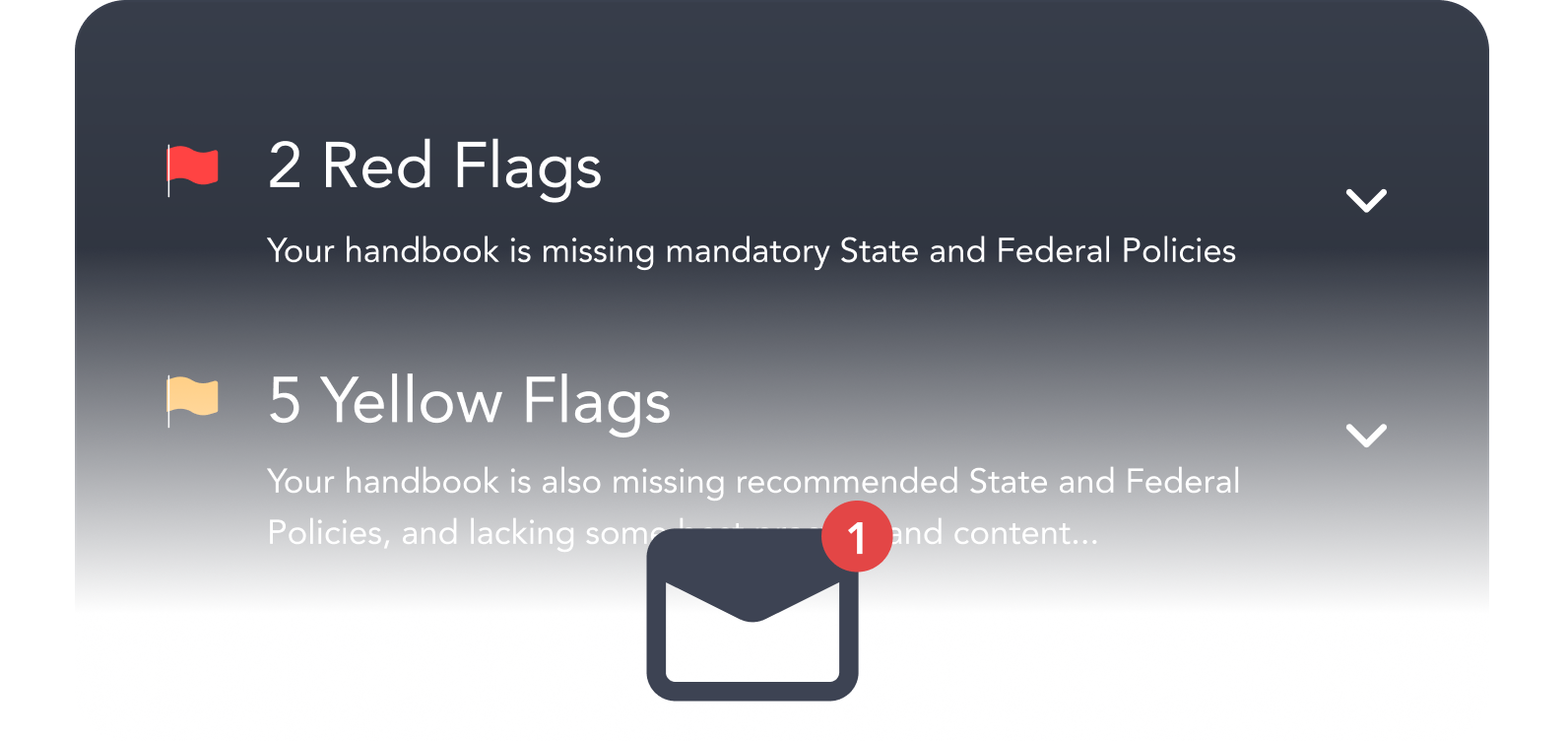
Understanding Louisiana Employee Handbook Requirements
Louisiana takes a minimalist approach to state employment law, with just 5 state-specific handbook policies. That puts it in the bottom tier nationally for state-level compliance requirements. But the laws it does have pack a disproportionate punch, particularly around final pay and wage deductions.
The 5 policies break down across four categories: Leave (1 policy on emergency response leave), Wage & Hour (2 policies covering wage deductions and minor break requirements), Compliance (1 policy on the Smoke-Free Air Act), and Termination Pay (1 policy on final pay timing). All 5 are classified as high risk because each carries direct penalties or enforcement mechanisms.
Louisiana's approach is notable for what it omits as much as what it includes. There is no state minimum wage, no state-mandated paid sick leave, no state FMLA equivalent, and no comprehensive state anti-discrimination statute covering private employers. Federal law fills almost all of these gaps, which means your handbook still needs to address them, just under federal rather than state authority.
The Federal Layer That Carries Most of the Weight
Because Louisiana adds so few state-specific requirements, federal employment law becomes the primary compliance framework for Louisiana employers. This is not a loophole or a shortcut. Your obligations under federal law are identical whether you operate in Louisiana or California.
Here is what applies at each employee count threshold:
- 1+ employees: FLSA (minimum wage, overtime), OSHA (workplace safety), EPPA (polygraph restrictions), IRCA (employment eligibility verification)
- 15+ employees: Title VII (discrimination), ADA (disability accommodation), GINA (genetic information), Pregnant Workers Fairness Act
- 20+ employees: ADEA (age discrimination), COBRA (health insurance continuation)
- 50+ employees: FMLA (family and medical leave), ACA (employer health insurance mandate)
- 100+ employees: WARN Act (plant closing notice)
Louisiana's lack of a state civil rights employment statute means that employers with fewer than 15 employees have virtually no anti-discrimination obligations beyond what they voluntarily adopt in their handbooks. That changes the moment you hit 15 employees and Title VII kicks in.
Emergency Response Leave and Louisiana's Unique Disaster Profile
Louisiana's emergency response leave provision reflects the state's unique vulnerability to natural disasters. Hurricanes, flooding, and tropical storms create situations where first responders, volunteer firefighters, EMTs, and other emergency personnel must leave their regular jobs to serve their communities.
Under Louisiana law, employers may not terminate, discipline, or otherwise penalize employees who are absent from work because they are responding to a declared emergency in their capacity as a first responder or volunteer emergency worker. This protection covers a broad range of personnel, including volunteer firefighters, emergency medical technicians, auxiliary law enforcement, Civil Air Patrol members, and state agency essential workers.
For employers in Louisiana, this means your handbook should acknowledge emergency response leave as a protected absence. You do not need to pay employees during the leave (unless your policy says otherwise), but you cannot treat the absence as a no-call/no-show or count it against them under an attendance policy.
The practical challenge is verification. When a hurricane hits and employees do not show up claiming emergency response duties, how do you confirm they were actually called to serve? Best practice: require employees to provide documentation from the emergency management agency or fire department within a reasonable time after returning to work, and state this expectation in your handbook.
Keeping Your Louisiana Handbook Current in 2026
Louisiana's legislature does not generate the volume of employment bills that states like California or New York do, but changes still happen, and federal updates apply to every Louisiana employer. Here is what to watch for in 2026:
- Federal minimum wage proposals: Louisiana has no state minimum wage and preempts local minimums, so any change must come from the federal level. Multiple proposals are active in Congress.
- FLSA salary threshold updates: Changes to the overtime exemption salary threshold affect Louisiana employers who classify employees as exempt. Review your classifications if thresholds change.
- Pregnant Workers Fairness Act enforcement: The EEOC continues to issue guidance under this federal law. Louisiana employers with 15+ employees need accommodations policies.
- Paid leave proposals: While Louisiana has historically resisted state-mandated paid leave, legislative proposals surface periodically. Monitor the current session for any movement.
AirMason's handbook builder tracks both federal and Louisiana-specific changes and pushes updates to customers automatically. If you are unsure whether your current handbook covers all 2026 requirements, run a free compliance audit. It takes minutes and tells you exactly where the gaps are.
Frequently Asked Questions
Explore Other State Requirements
More Resources
Build a Compliant Louisiana Employee Handbook
Expert-curated policies, updated weekly, built for how HR teams actually work.