Idaho Employee Handbook Requirements (2026)
Idaho keeps its state-level employment requirements lean, but that does not mean you can skip the handbook. Federal law still carries the weight, and the few Idaho-specific rules carry real consequences when employers overlook them. Here is what you need to cover and where the gaps usually show up. Please keep in mind requirements may vary based on company size, industry, location, and workforce composition.






At a Glance
Policy Breakdown by Category
Idaho requires 5 state-specific handbook policies. Here's what each one covers, without the legalese.
Leave
3 policiesWage & Hour
1 policyTermination Pay
1 policyNeed the Complete Idaho Addendum?
Get the full policy language for all 5 Idaho requirements, kept updated every week by our compliance team.
Talk to Our TeamCommon Compliance Pitfalls in Idaho
The mistakes we see most often, and how to avoid them.
Idaho Code 45-606 gives employers a relatively generous default timeline for final pay: the next regular payday or 10 days after separation, whichever comes first. That sounds manageable. But there is a clause buried in the same statute that most employers miss entirely.
If a departing employee submits a written request for earlier payment, the employer must deliver all wages due within 48 hours of receiving that request, excluding weekends and holidays. That is not 48 business hours. That is 48 hours from when the request lands on your desk.
The Idaho Department of Labor enforces wage claims under the Idaho Wage Claim Act (Idaho Code 45-601 et seq.), and unpaid wage complaints are one of their most common case types. While Idaho does not impose California-style waiting time penalties, the Department can order payment of wages owed plus administrative costs, and willful violations can be referred for criminal prosecution as a misdemeanor.
The practical fix is straightforward: build a final pay checklist that accounts for the 48-hour written request scenario. If you use a payroll provider, confirm they can process off-cycle payments within that window. Most payroll systems can, but only if someone actually initiates the run.
Sources: Idaho Code Sec. 45-606; Idaho Wage Claim Act (Idaho Code 45-601 et seq.).
Most employers know about USERRA (the Uniformed Services Employment and Reemployment Rights Act), the federal law that protects military service members from employment discrimination and guarantees reemployment rights. What they often do not realize is that Idaho adds its own layer on top.
Idaho Code 46-409, known as the Militia Civil Relief Act, extends USERRA-equivalent protections to members of the Idaho National Guard who are called to state active duty by the governor. This is distinct from federal active duty. When the governor declares a state emergency and activates the Guard, those employees get the same reinstatement rights, seniority protections, and anti-retaliation provisions that USERRA provides for federal deployments.
Separately, Idaho Code 46-216 provides that state and local government employees who are members of the National Guard receive up to 15 days of paid military leave per year for training purposes. Private employers are not required to provide paid leave, but the reemployment protections still apply.
Where employers get tripped up: treating state activation differently from federal deployment. From a compliance standpoint, the employee returning from a governor-ordered activation has the same right to their old job (or a comparable one) as someone returning from overseas deployment. Denying reinstatement after a state emergency activation violates Idaho law.
Sources: Idaho Code Sec. 46-409 (Militia Civil Relief Act); Idaho Code Sec. 46-216 (Military Leave for Government Employees); 38 U.S.C. Sec. 4301 et seq. (USERRA).
Idaho is one of a handful of states that has not set its own minimum wage above the federal floor. The state minimum wage is $7.25 per hour, matching the federal rate set by the Fair Labor Standards Act. For youth workers under 20, employers can pay $4.25 per hour for the first 90 consecutive calendar days of employment.
The youth subminimum wage provision is where compliance problems tend to surface. The 90-day clock starts on the employee's first day of work, not their first day at the current position. If a 19-year-old worked for you last summer, quit, and comes back this summer, the 90 days may have already expired during their first stint. Paying them $4.25 again would be a wage violation.
Another issue: the displacement prohibition. Under the FLSA youth subminimum wage rules, employers cannot displace existing employees (including reducing their hours) in order to hire youth workers at the lower rate. This is a federal rule, but it applies in Idaho because the state defers to the federal framework. An employer who lays off a $7.25/hour worker and replaces them with a $4.25/hour youth worker has a problem.
Finally, while the state minimum is $7.25, some Idaho cities have explored higher local minimums through ballot initiatives. If your workforce spans multiple locations, verify the applicable rate for each.
Sources: Idaho Code Title 44, Chapter 15 (Minimum Wage); 29 U.S.C. Sec. 206 (FLSA Minimum Wage); 29 U.S.C. Sec. 206(g) (Youth Subminimum Wage).
Idaho is a strong at-will employment state. Employers can terminate employees for any reason or no reason, as long as it does not violate a specific law. But the Idaho Supreme Court has recognized a public policy exception to at-will employment that catches some employers off guard.
In Hummer v. Evans (1982) and subsequent decisions, the Court held that terminating an employee for exercising a legal right or refusing to perform an illegal act can give rise to a wrongful discharge claim. This is narrower than some states' exceptions, but it is real and enforceable.
The most common triggers in Idaho include firing an employee for filing a workers' compensation claim, for serving on a jury, or for refusing to violate a safety regulation. None of these require a specific anti-retaliation statute; the public policy exception covers them directly.
Having a well-drafted at-will disclaimer in your handbook helps, but only if it does not overreach. Language suggesting the employer can terminate "for any reason whatsoever, without exception" could be used against you in a wrongful discharge case as evidence that the company did not even acknowledge the existence of legal limits. The better approach: state the at-will relationship clearly, but acknowledge that it operates within the bounds of applicable law.
Sources: Hummer v. Evans, 102 Idaho 128 (1981); Sorensen v. Comm Tek, Inc., 118 Idaho 664 (1990); Idaho at-will employment doctrine.
Idaho Has 3 Employer Notice Requirements
Beyond handbook policies, Idaho employers must provide specific notices to employees for events like new hires, terminations, and qualifying events.
View Idaho Notice Requirements →Check Your Idaho Compliance in Minutes
Upload your handbook and get an instant compliance report, checked against 1,000+ rules including Idaho-specific requirements.
Try Our Free Employee Handbook Audit →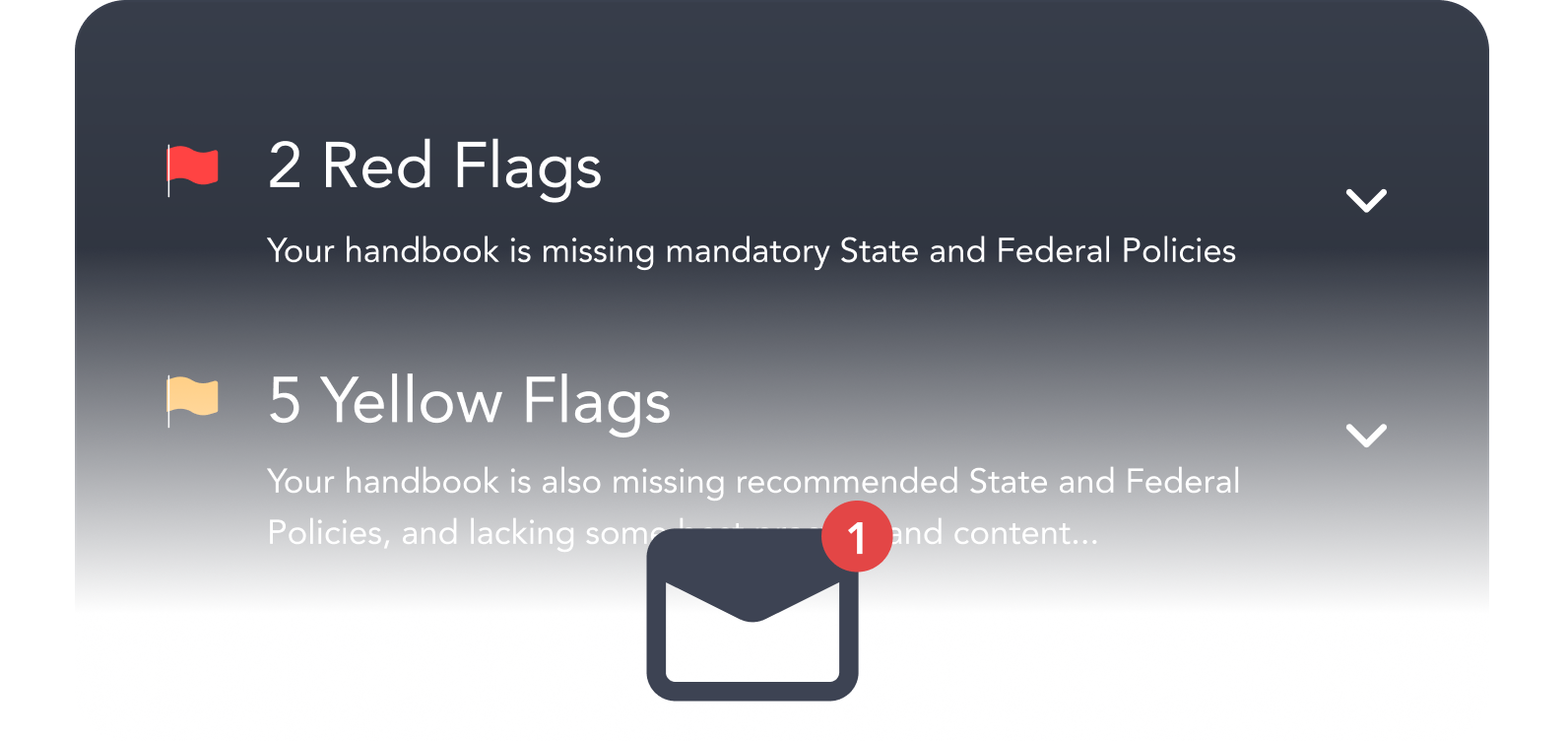
Understanding Idaho Employee Handbook Requirements
Idaho is one of the most employer-friendly states in the country when it comes to employment regulation. With just 5 state-specific handbook policies, it ranks near the bottom nationally for compliance burden. But that low count can create a false sense of security.
The policies Idaho does require are straightforward: military leave protections that mirror and extend federal USERRA, jury duty leave, voting accommodations, minimum wage compliance, and final pay timing rules. None of these are optional, and each carries enforcement mechanisms through the Idaho Department of Labor or the courts.
What Idaho lacks in state-specific regulation, federal law fills in. FMLA, Title VII, ADA, ADEA, OSHA, and the FLSA all apply to Idaho employers who meet their respective thresholds. Your handbook needs to address those federal requirements regardless of state law. An Idaho employer with 50 employees has nearly as many compliance obligations as one in a more heavily regulated state; the difference is that most of those obligations come from federal rather than state sources.
The 5 state policies break down into three categories: Leave (3 policies covering military, jury duty, and voting), Wage & Hour (1 policy on minimum wage), and Termination Pay (1 policy on final paycheck timing).
Why "Employer-Friendly" Does Not Mean "Handbook-Optional"
Idaho employers sometimes assume that because the state has few mandated policies, a formal employee handbook is unnecessary. This is a mistake that creates legal exposure on multiple fronts.
First, federal law does not care where your company is located. An Idaho employer with 50+ employees still needs FMLA policies, ADA interactive process documentation, FLSA overtime classifications, and OSHA safety programs. Those requirements exist whether your state adds to them or not.
Second, the Idaho Supreme Court has recognized implied contract claims arising from employee handbooks. If your verbal promises or informal policies create an expectation of job security, an employee can argue that the at-will relationship was modified. A clear, well-drafted handbook with a conspicuous at-will disclaimer is the best defense against implied contract claims.
Third, even Idaho's handful of state requirements carry real enforcement weight. The Idaho Department of Labor processes wage claims under the Idaho Wage Claim Act, and violations can result in orders to pay wages owed plus administrative penalties. For military leave violations, employees can bring claims under both state and federal law simultaneously.
The bottom line: a lean regulatory environment does not reduce the need for a handbook. It just means your handbook can be shorter. But it still needs to exist, and it still needs to be accurate.
Federal Requirements That Apply to Idaho Employers
Because Idaho adds relatively few state-specific rules, the federal compliance layer becomes the primary source of handbook requirements for most Idaho employers. Here are the key thresholds:
- 1+ employees: FLSA minimum wage and overtime, OSHA workplace safety, EPPA (lie detector restrictions), IRCA (employment eligibility verification)
- 15+ employees: Title VII (discrimination), ADA (disability accommodation), GINA (genetic information), Pregnant Workers Fairness Act
- 20+ employees: ADEA (age discrimination), COBRA (continuation health coverage)
- 50+ employees: FMLA (family and medical leave), ACA employer mandate (health insurance)
- 100+ employees: WARN Act (plant closing and mass layoff notice)
Each threshold triggers new handbook requirements. An Idaho company growing from 14 to 16 employees suddenly needs to comply with Title VII, ADA, and GINA, even though none of those are state laws. Your handbook should be updated proactively as you approach these thresholds, not after you have already crossed them.
If you are unsure whether your current handbook covers all applicable federal and state requirements, run a free compliance audit. It checks against 1,000+ rules and shows you exactly where the gaps are.
Keeping Your Idaho Handbook Current in 2026
Idaho's legislative calendar is quieter than states like California or New York when it comes to employment law, but that does not mean you can set your handbook on autopilot. Federal changes apply to Idaho employers just like everyone else, and the state does pass employment-related legislation from time to time.
For 2026, Idaho employers should pay attention to:
- Federal minimum wage discussions: While no increase has passed at the federal level, several proposals are active. Idaho's minimum wage is pegged to the federal rate, so any federal increase would automatically apply.
- FLSA salary threshold updates: Changes to the overtime exemption salary threshold affect Idaho employers who classify employees as exempt. Make sure your classifications are current.
- Pregnant Workers Fairness Act enforcement: The EEOC continues to issue guidance and enforcement actions under this relatively new federal law. Idaho employers with 15+ employees need accommodations policies in place.
- FTC non-compete rule status: Federal non-compete restrictions could affect Idaho employers depending on the outcome of ongoing litigation.
AirMason's handbook builder tracks both federal and state-level changes and pushes updates to customers automatically. If you are managing compliance manually, build a calendar reminder to review your handbook at minimum every January and again mid-year to catch any changes you may have missed.
Frequently Asked Questions
Explore Other State Requirements
More Resources
Build a Compliant Idaho Employee Handbook
Expert-curated policies, updated weekly, built for how HR teams actually work.