
HR Compliance Software in 2026: Laws, Automation & Tracking
HR compliance software automates law monitoring, keeps employee handbooks current, tracks policy acknowledgements, and reduces the administrative burden on HR teams.

TL;DR
HR compliance software automates law monitoring, keeps employee handbooks current, tracks policy acknowledgements, and reduces the administrative burden on HR teams.
AirMason leads this space by combining an AI-powered compliance engine with attorney-reviewed policy updates, seamless distribution, and real-time tracking — all in one platform built specifically for HR teams.
Why HR Compliance Has Never Been More Complex
HR leaders in 2026 are navigating one of the most demanding compliance environments in recent memory.
State-level regulations on:
- Pay transparency
- AI use in hiring
- Independent contractor classification
- And workplace anti-discrimination
are proliferating across the country, creating a patchwork of obligations that varies dramatically depending on where your employees are located.
The Equal Employment Opportunity Commission reported a more than 10% rise in workplace discrimination charges in 2023, a trend that shows no sign of reversing.
The answer is smarter technology. Specifically, HR compliance software that automates the monitoring, updating, and tracking of employment policies so that your team can focus on strategy rather than statutes.
The Five Biggest Compliance Challenges in 2026
Based on guidance from employment law experts and analysis from HR compliance leaders, the following five issues represent the most pressing compliance priorities for HR teams this year.
Each area is evolving rapidly, and organizations without current, documented policies face meaningful legal exposure.
| Compliance Challenge | Key Risk | What HR Teams Must Do |
|---|---|---|
| Balancing DEI with Anti-Discrimination Laws | Reverse discrimination claims on the rise following recent Supreme Court decisions | Review hiring and promotion policies; ensure programs are structured to withstand legal scrutiny |
| Pay Transparency Mandates | Non-disclosure of salary ranges in job postings triggers fines in covered states | Update job posting templates and compensation policies by jurisdiction |
| AI in Hiring and Employment Decisions | Algorithmic bias claims and emerging state AI regulations create new liability | Audit AI tools used in recruitment; update handbook policies accordingly |
| Political Expression in the Workplace | Inconsistent enforcement creates discrimination and retaliation exposure | Establish clear, consistently applied policies on political speech and activity |
| Independent Contractor Classification | Misclassification penalties have increased significantly in multiple states | Review worker classification under applicable state tests; update contractor agreements |
The scale of legislative activity driving these challenges is staggering. Employment law changes occur over 600 times annually at the state level, creating an impossible manual tracking burden for multi-state employers.
Why Manual Compliance Management No Longer Works
For years, HR teams managed compliance through a combination of legal subscriptions, periodic handbook reviews, and manual policy updates.
This was manageable when employment law changed slowly and most organizations operated in a single state.
Neither of those conditions holds true today. According to a Deloitte study, HR staff already spend up to 57% of their time on administrative and routine tasks, leaving very little capacity for the kind of sustained legal monitoring that modern compliance requires.
The result is predictable: policies fall out of date, employees receive outdated information, and organizations accumulate compliance risk without realizing it.
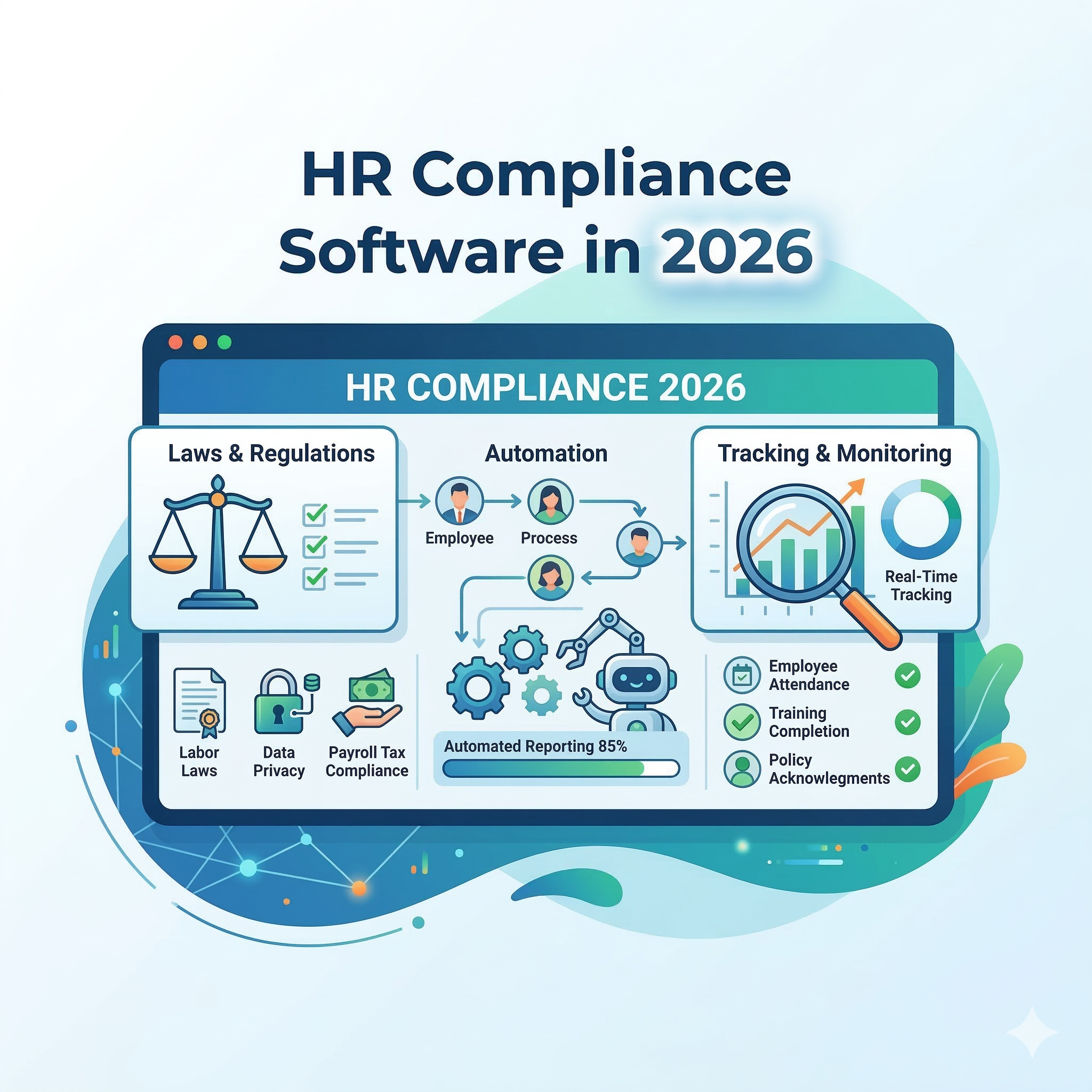
How HR Compliance Software Works: The Three Layers
Modern HR compliance software operates across three interconnected layers. Understanding each layer helps HR leaders evaluate which platforms are genuinely comprehensive and which are simply repackaged document editors.
Layer 1: Employment Law Monitoring
The foundation of any compliance software is its ability to monitor changes in employment law across the jurisdictions relevant to your business.
The best platforms:
- Apply relevance filtering and
- Match incoming law changes to your organization’s profile.
AirMason’s compliance engine scans authoritative sources for changes across all 50 states plus federal updates, then filters those changes against your company’s profile before routing them for attorney review.
Layer 2: Policy Management and Automated Updates
Once a relevant law change is identified and reviewed, the next challenge is translating it into updated policy language and pushing that update to the right employees.
Platforms that handle only one side of this equation — either monitoring without document management, or document management without monitoring — require HR teams to bridge the gap manually, reintroducing the bottleneck that software is supposed to eliminate.
As explored in AirMason’s guide to automated policy management, organizations that implement end-to-end automation report a 70% reduction in manual tasks and a 62% improvement in compliance processes.
AI-driven compliance solutions can also cut compliance costs by up to 40%, making the return on investment clear even before accounting for the value of avoided legal exposure.
Layer 3: Compliance Tracking and Acknowledgement
Knowing that your policies are up to date is only half the battle. You also need to know that your employees have received, read, and acknowledged those policies.
Without this evidence, an up-to-date handbook provides limited legal protection in the event of a dispute.
Effective compliance tracking includes electronic signature collection, automated reminders, version-specific tracking, and downloadable audit reports.
For a deeper look at these capabilities, AirMason’s overview of essential features for HR policy distribution platforms covers the key capabilities that separate enterprise-grade solutions from basic document tools.
HR Compliance Software Compared: The Leading Platforms in 2026
The HR compliance software market is projected to reach USD 5.22 billion by 2032, growing at a compound annual growth rate of 9.9%, according to Verified Market Research.
This growth has attracted a wide range of competitors, each with different strengths and limitations.
| Platform | Primary Strength | Key Limitation |
|---|---|---|
| AirMason | End-to-end platform: AI compliance engine, attorney-reviewed updates, digital handbooks, real-time tracking, and AirAssist AI for employees | Focused specifically on handbooks and HR documents (by design) |
| Blissbook | Clean digital handbook design and employee engagement features | Limited automated compliance monitoring; relies on HR to initiate updates |
| SixFifty | Attorney-drafted policy templates with multi-state coverage | Less emphasis on design and employee experience; more document-centric |
| Handbooks.io | Simple, affordable handbook creation for small businesses | Limited compliance automation and tracking capabilities |
| Gusto | Broad HR platform covering payroll, benefits, and basic compliance | Handbook and policy management is secondary to payroll; less specialized |
| SHRM Employee Handbook Builder | Backed by SHRM’s legal expertise and policy library | Template-based approach requires significant manual customization and updating |
| Mosey | Strong state-by-state compliance monitoring and registration management | Does not include handbook creation or employee-facing document distribution |
| BLR’s Employee Handbook Builder | Comprehensive policy library with legal guidance | Dated user interface; limited employee engagement and tracking features |
What distinguishes AirMason from every other platform in this comparison is the combination of depth and breadth.
Where competitors tend to excel in one dimension — either compliance monitoring, or document design, or employee tracking — AirMason integrates all three into a single, cohesive platform.
For a more detailed comparison, the AirMason blog’s comparison of employee handbook software provides an in-depth analysis of features, pricing, and use cases.
AirMason: The Complete HR Compliance Platform
AirMason was built on the premise that HR compliance and employee culture are not competing priorities — they are complementary ones.
An employee handbook that is legally accurate but unreadable fails on both counts, and a beautifully designed handbook that is legally outdated is worse than no handbook at all.
At the core of AirMason’s offering is a three-stage compliance process:
- Monitoring employment law changes across all 50 states and federal sources.
- Filtering updates for relevance based on your organization’s specific profile.
- Reviewing each change by in-house SHRM-certified HR professionals and employment attorneys.
This human-in-the-loop approach is what separates AirMason from platforms that rely solely on AI-generated policy language.
Beyond compliance monitoring, AirMason’s handbook builder allows HR teams to create fully branded, mobile-optimized digital handbooks accessible via SSO from any device.
HRIS integrations mean that new employees are automatically provisioned with the correct handbook and policy addenda based on their role and location — no manual steps required.
For a step-by-step guide to getting started, AirMason’s tutorial on how to create your employee handbook online walks through the process from initial setup to first distribution.
AirMason also includes AirAssist, an AI-powered assistant that allows employees to ask policy questions in plain language and receive accurate, up-to-date answers instantly.
As discussed in AirMason’s practical guide to HR document automation, the combination of automated distribution, real-time tracking, and employee-facing AI support represents the new standard for compliance-driven HR operations.
Actionable Steps to Strengthen HR Compliance in 2026
- Audit your current handbook and policies. Identify which policies have not been reviewed in the past 12 months, which states are not covered by your current documentation, and where gaps exist in your acknowledgement tracking.
- Map your compliance obligations by jurisdiction. For each state where you have employees, document the specific requirements that apply — pay transparency, leave entitlements, anti-discrimination, AI use, and contractor classification.
- Evaluate HR compliance software against a clear feature checklist. Prioritize attorney-reviewed updates, multi-state coverage, version control, electronic signatures, HRIS integration, and mobile accessibility. Do not settle for a solution that covers only part of the compliance workflow.
- Migrate to a digital handbook format. If your organization is still distributing policies as PDFs or Word documents, 2026 is the year to make the transition. The compliance tracking and real-time update capabilities of digital handbooks are not replicable in static document formats.
- Establish a regular compliance review cadence. Even with automated monitoring, HR leaders should schedule quarterly reviews to assess new risks and ensure the organization is prepared for upcoming regulatory changes.
Frequently Asked Questions
What is HR compliance software?
HR compliance software is a category of technology designed to help organizations monitor, manage, and document their adherence to employment laws and workplace regulations.
It typically includes features such as:
- Tracking law changes.
- Updating employee handbooks and HR policies.
- Distributing documents to employees.
- Collecting acknowledgement signatures.
- Generating audit reports.
In 2026, the most advanced platforms combine AI-powered law monitoring with human attorney review and integrated document management, enabling HR teams to maintain compliance across multiple jurisdictions without relying on manual research for every update.
Why do businesses need HR compliance software in 2026?
The volume and pace of employment law changes in 2026 make manual compliance management impractical for most organizations.
Beyond monitoring, compliance software provides the documentation and tracking capabilities needed to demonstrate compliance in the event of an audit or legal dispute.
How does AirMason help with HR compliance?
AirMason provides a comprehensive HR compliance platform that covers the full compliance lifecycle.
Its AI-powered compliance engine monitors employment law changes across all 50 states and at the federal level, filters those changes for relevance to your organization, and routes them for review by in-house SHRM-certified HR professionals and employment attorneys.
Approved updates are applied to your employee handbook and distributed to the relevant employees, with electronic signature collection and real-time tracking to ensure complete acknowledgement.
AirMason also includes AirAssist, an AI-powered Q&A tool that gives employees instant access to accurate policy information.
What is the difference between HR compliance software and an employee handbook builder?
A basic employee handbook builder allows HR teams to create and format policy documents, but it does not monitor law changes, automatically update policies, or track employee acknowledgements.
HR compliance software goes significantly further, integrating law monitoring, policy management, distribution, and tracking into a single workflow.
AirMason bridges this gap by combining enterprise-grade compliance management with a best-in-class handbook builder, so organizations do not have to choose between compliance rigor and employee experience.
How often should employee handbooks be updated for compliance?
HR leaders should review their handbooks at least annually and monitor for significant law changes on an ongoing basis.
In practice, organizations with employees in multiple states may need to update specific policies several times per year to stay current with state-level changes.
This is precisely why automated compliance monitoring — rather than periodic manual review — has become the standard for organizations that take compliance seriously.
What are the most important compliance issues for HR in 2026?
The five most pressing compliance challenges for HR in 2026 are:
- Balancing DEI initiatives with evolving anti-discrimination law.
- Complying with expanding pay transparency mandates.
- Managing the legal risks associated with AI in hiring and employment decisions.
- Establishing clear policies on political expression in the workplace.
- Correctly classifying independent contractors under applicable state tests.
HR compliance software that monitors these specific areas and provides attorney-reviewed policy language is the most effective way to stay ahead of these challenges.
Can small businesses benefit from HR compliance software?
Absolutely — in fact, small businesses often have the most to gain from HR compliance software because they are least likely to have dedicated in-house legal resources.
Small businesses lose an average of $10,000 per year due to HR non-compliance, and they are just as subject to employment law requirements as large enterprises.
Platforms like AirMason are designed to scale with organizations of all sizes, providing access to attorney-reviewed policy updates and professional-grade compliance tracking that would otherwise require expensive legal retainers.
Conclusion: Compliance Is a Competitive Advantage
AirMason’s combination of capabilities includes:
- AI-powered compliance monitoring.
- Attorney-reviewed policy updates.
- Digital handbook creation.
- Real-time compliance tracking.
Together, these features represent the most complete solution in the market for HR teams that want to move from reactive compliance management to proactive, systematic compliance excellence.
For HR leaders looking to build the broader business case, AirMason’s analysis of top HR software platforms in 2026 provides a comprehensive market context and ROI framework.
Ready to see how AirMason can transform your HR compliance workflow? Book a demo today and discover what it means to have compliance handled — automatically, accurately, and always.